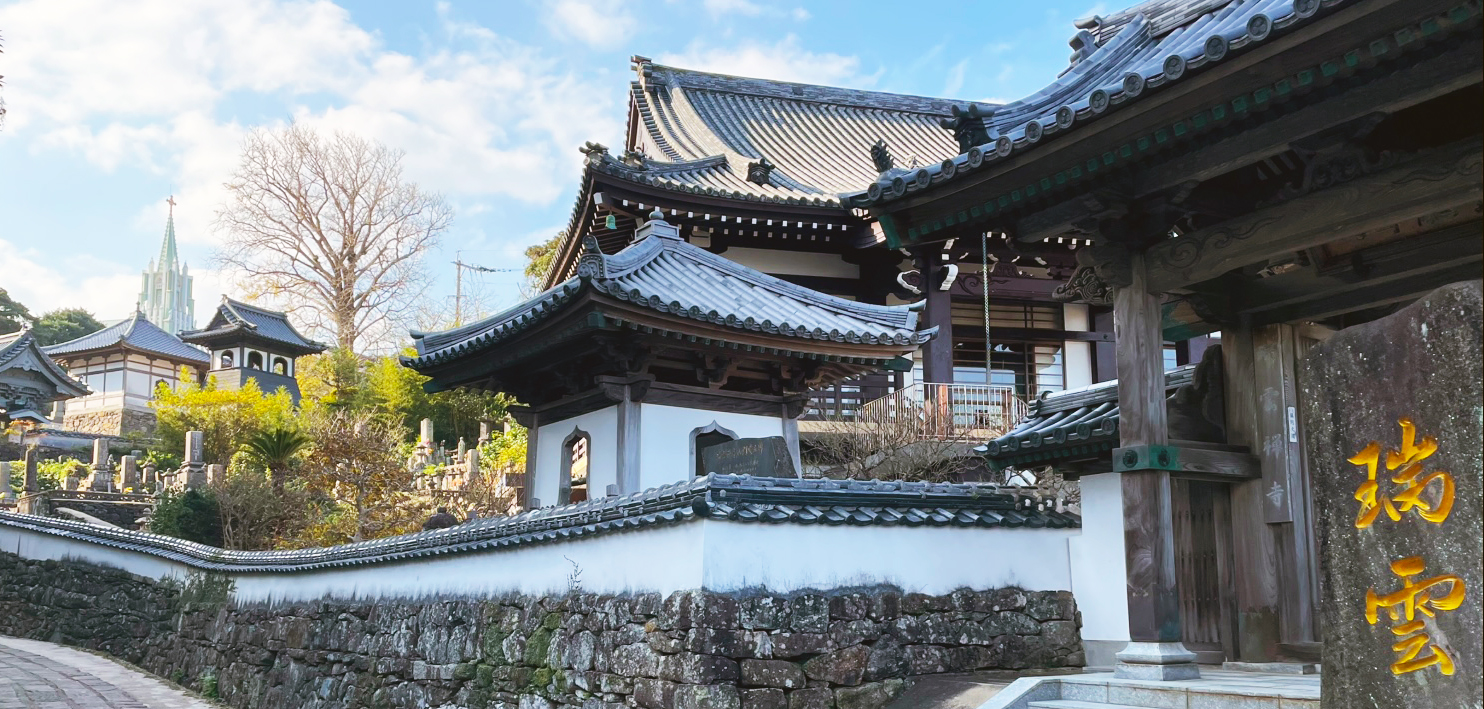
An easy walking tour exploring Saga and Nagasaki Prefectures, a lesser-visited region that was once a nexus of international trade, cultural exchange and intrigue.
A gentle walking tour, suitable for the most leisurely walker, through what was once Japan’s gateway to the world. An exploration of Japan’s history from the times of the Silk Road: samurai warlords, Portuguese missionaries, Dutch and British traders, nineteenth-century Western explorers, ceramics, tea; onsen hot spring bathing, plush Japanese inns and hotels complemented with varied cuisine of the region.
Year-round.
Saga and Nagasaki: Cultural Crossroads is a fully-guided tour suitable for anyone who can walk for more than two hours in comfort. The walking is light and generally on level pavement but does also include some short climbs and descents; these are mostly in Nagasaki on Day 6. Please read more on Tour Levels here.
A 10-day, 9-night tour starting in Hakata (Fukuoka City) and finishing in Kumamoto. Accommodation is in Japanese inns and hotels. Please read more on accommodation here. The maximum group size for this tour is 12 persons. We have no minimum size. If we accept a booking we guarantee to run the tour. Participants are provided with easily followed, detailed instructions on how to join the tour.
Saga and Nagasaki: Cultural Crossroads is a Level 2 easy walking fully-guided tour that takes us to the furthest westerly extent of Kyushu. The region was long the gateway to South Korea, China, South-east Asia and Europe. Asian peoples mingled here millenia ago but Europeans, first Portuguese and then Spanish missionaries and traders, arrived in the 1540s, while Dutch and British traders followed in the early 17th Century. Over two centuries later, in the 1860s, a new wave of westerners followed from Europe and North America.
We delve into the exploits of these visitors including William Adams, the first Englishman to arrive in Japan who subsequently became a senior samurai and confidant of the great shogun Tokugawa Ieyasu. Adams' fascinating life story was fictionalised by James Clavell in his best-selling novel Shogun, which was then turned into the hit Hollywood TV series of the same name. We also come across other characters who made treacherous multi-year journeys under sail across the high seas to find fame and fortune, such as the Dutch whose movements were restricted to Dejima, a small man-made island in Nagasaki harbour; Thomas Glover, a Scotsman and merchant who helped topple the shogunate in the late 1860s and went on to be a key figure in Japan's industrialisation; and Jacques Mayol, a Frenchman who learnt to swim as a child in Saga and went on to become a record holding free-diver and subject of the film Le Grand Bleu, or Big Blue, directed by Luc Besson. Another intriguing historical character is Zheng Chenggong, a revered figure in China to this day, who was born to Japanese and Chinese parents in Hirado, a remote and elegant port town.
Our travels take us not only through Japan's history, but also through beautiful countryside to the heart of its porcelain crafts in Arita; the atmospheric coastal castle towns of Karatsu and Shimabara; onsen hot springs at Ureshino, Obama and Unzen; and to Nagasaki, one of Japan's most vibrant and cosmopolitan cities. We begin and end the tour in Fukuoka and Kumamoto, two popular and convenient cities.
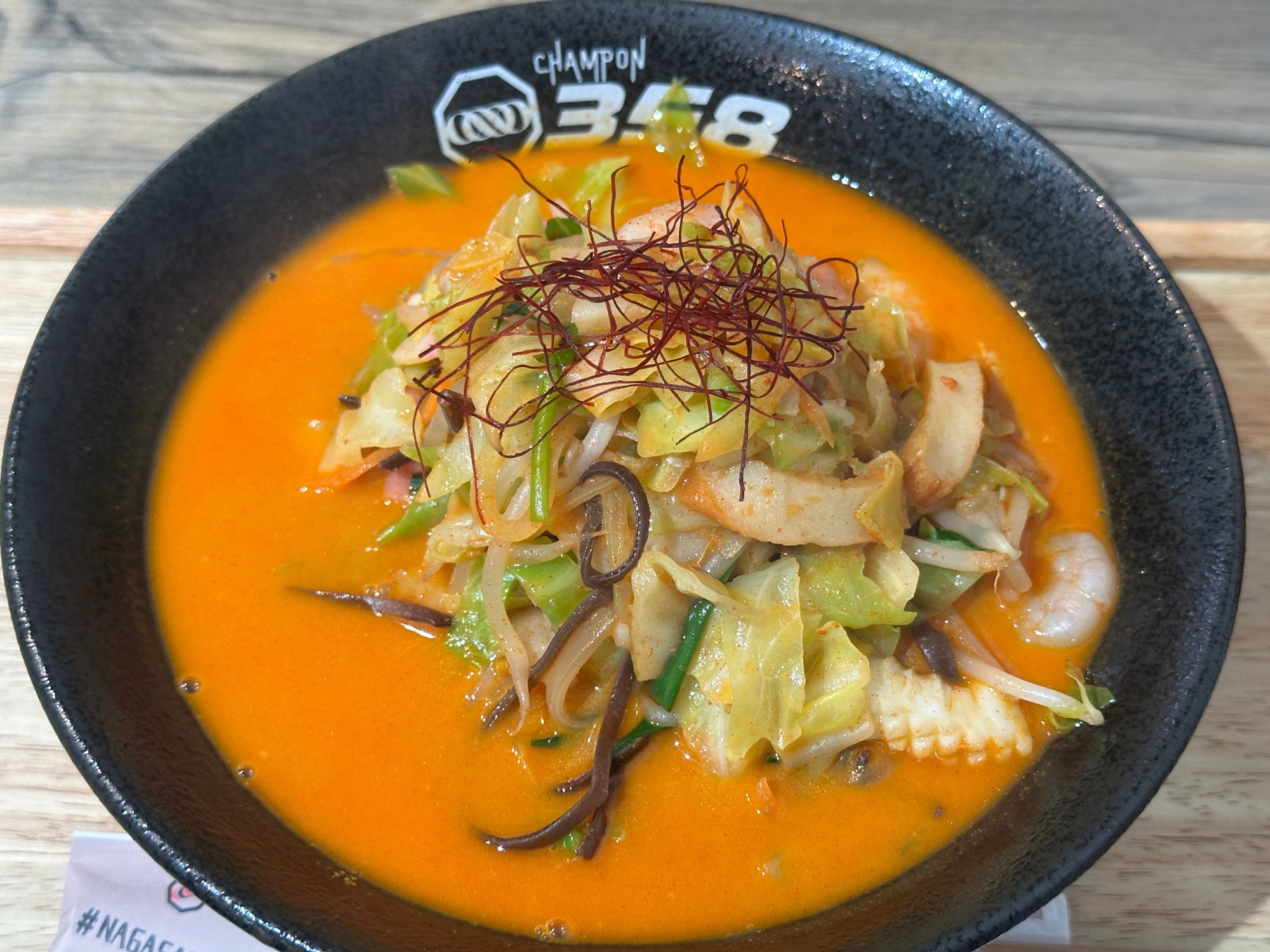
Every evening we stay in Japanese inns and hotels, and enjoy top quality Japanese cuisine throughout our journey. Walking includes some short inclines, usually over steps that are completed at an easy pace. On one occasion we raise our pace by boarding Japan's shortest Shinkansen bullet train line into Nagasaki City.
A 10-day, 9-night tour starting in Hakata (Fukuoka City) and finishing in Kumamoto. Accommodation is in Japanese inns and hotels. Please read more on accommodation here. The maximum group size for this tour is 12 persons. We have no minimum size. If we accept a booking we guarantee to run the tour. Participants are provided with easily followed, detailed instructions on how to join the tour.
Saga and Nagasaki: Cultural Crossroads is a Level 2 easy walking fully-guided tour that takes us to the furthest westerly extent of Kyushu. The region was long the gateway to South Korea, China, South-east Asia and Europe. Asian peoples mingled here millenia ago but Europeans, first Portuguese and then Spanish missionaries and traders, arrived in the 1540s, while Dutch and British traders followed in the early 17th Century. Over two centuries later, in the 1860s, a new wave of westerners followed from Europe and North America.
We delve into the exploits of these visitors including William Adams, the first Englishman to arrive in Japan who subsequently became a senior samurai and confidant of the great shogun Tokugawa Ieyasu. Adams' fascinating life story was fictionalised by James Clavell in his best-selling novel Shogun, which was then turned into the hit Hollywood TV series of the same name. We also come across other characters who made treacherous multi-year journeys under sail across the high seas to find fame and fortune, such as the Dutch whose movements were restricted to Dejima, a small man-made island in Nagasaki harbour; Thomas Glover, a Scotsman and merchant who helped topple the shogunate in the late 1860s and went on to be a key figure in Japan's industrialisation; and Jacques Mayol, a Frenchman who learnt to swim as a child in Saga and went on to become a record holding free-diver and subject of the film Le Grand Bleu, or Big Blue, directed by Luc Besson. Another intriguing historical character is Zheng Chenggong, a revered figure in China to this day, who was born to Japanese and Chinese parents in Hirado, a remote and elegant port town.
Our travels take us not only through Japan's history, but also through beautiful countryside to the heart of its porcelain crafts in Arita; the atmospheric coastal castle towns of Karatsu and Shimabara; onsen hot springs at Ureshino, Obama and Unzen; and to Nagasaki, one of Japan's most vibrant and cosmopolitan cities. We begin and end the tour in Fukuoka and Kumamoto, two popular and convenient cities.
Every evening we stay in Japanese inns and hotels, and enjoy top quality Japanese cuisine throughout our journey. Walking includes some short inclines, usually over steps that are completed at an easy pace. On one occasion we raise our pace by boarding Japan's shortest Shinkansen bullet train line into Nagasaki City.
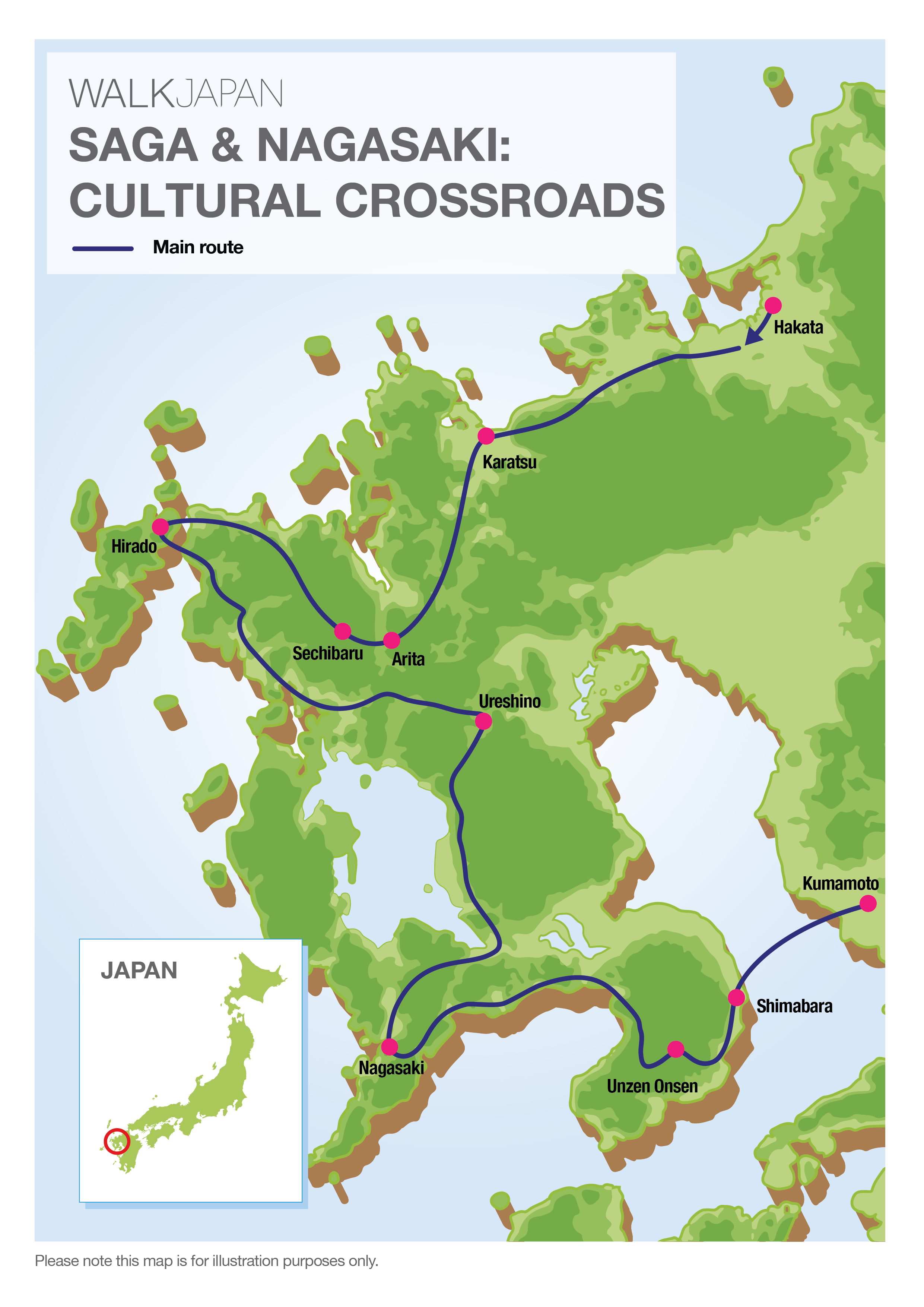
The itinerary for the Saga and Nagasaki: Cultural Crossroads is ground-only, beginning in Fukuoka and ending in Kumamoto. Prior to the tour, Walk Japan will provide detailed instructions for travelling to the meeting point in Fukuoka.
Your Walk Japan Tour Leader awaits everyone's arrival in the lobby of our hotel for an early evening start to the tour. The hotel is close by Hakata Station, which is Fukuoka's main railway station and convenient for arrival by both rail and air, and for our departure on Day 2. Your Tour Leader provides the tour briefing before dinner, which continues at a nearby restaurant.
Accommodation: Western-style hotel.
Meals: Dinner provided.
Total walking: N/A.
Total elevation gain: N/A.
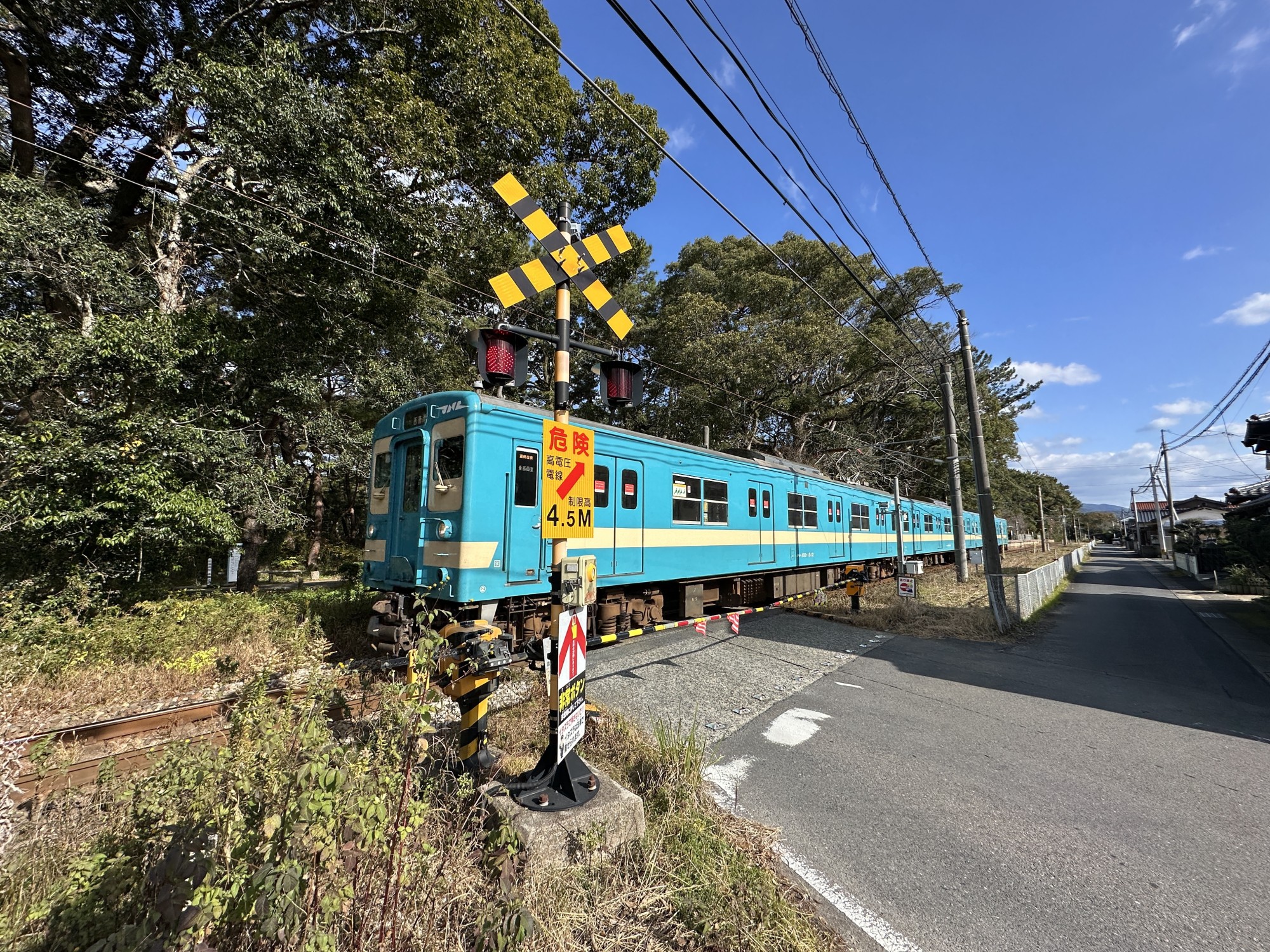
An early breakfast before we catch a local train to the beginning of our walk today on the northern coast of Saga Prefecture. Our luggage is sent ahead of us so all we need to take with us are our day packs.
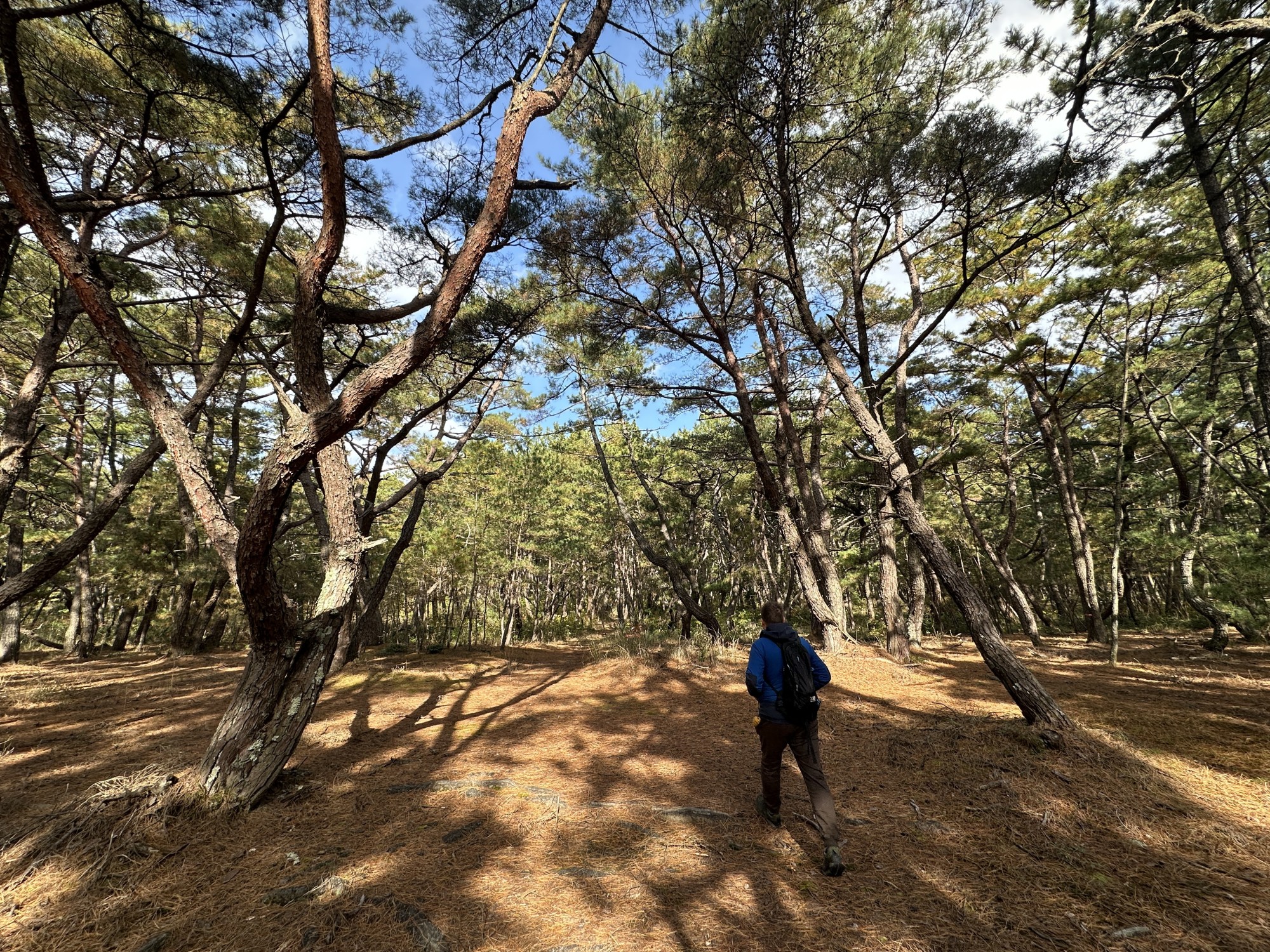
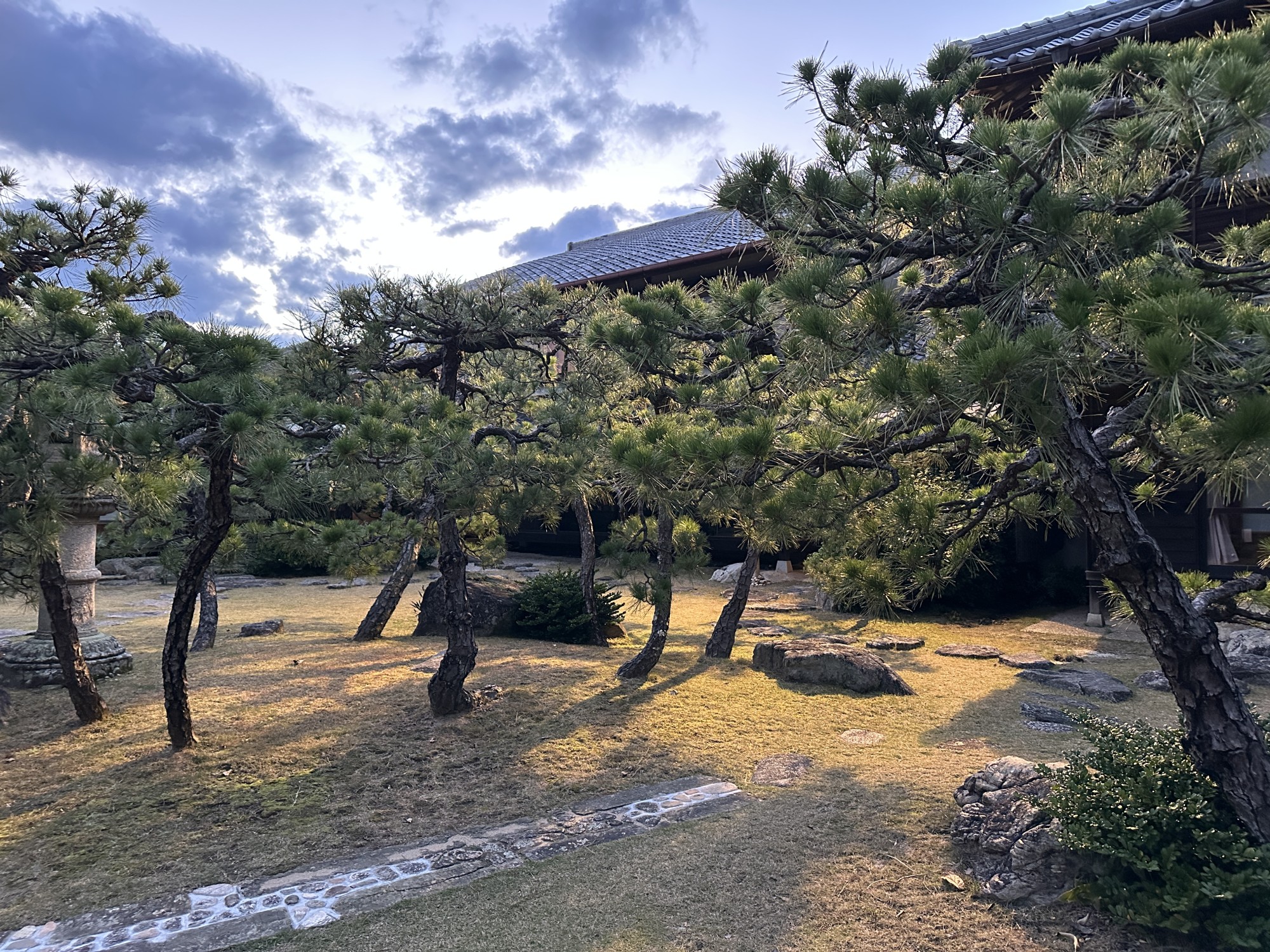
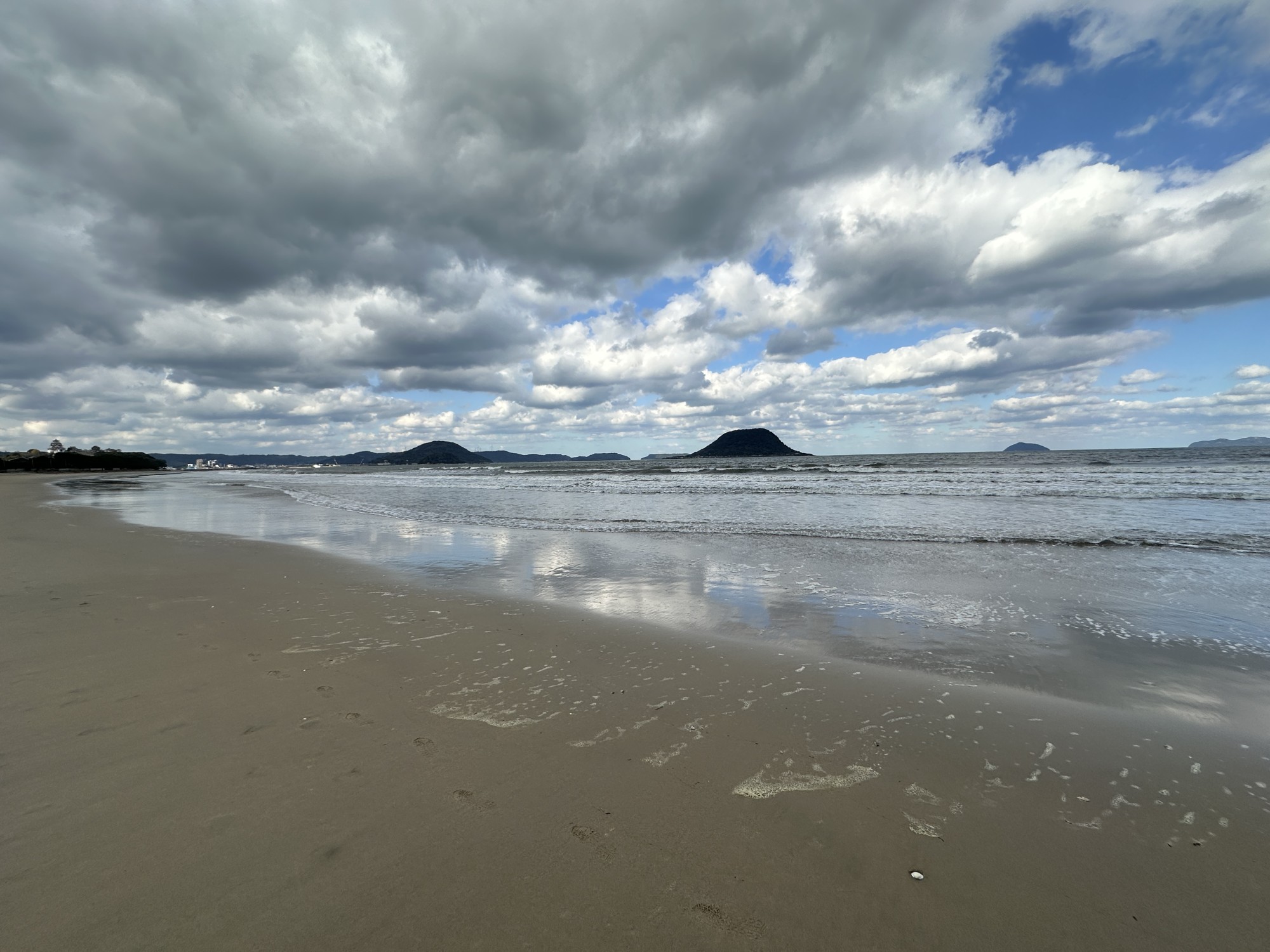
After about 75 minutes we find ourselves journeying aside the Genkai Sea on Kyushu's northern coast before the view is obscured by a pine forest. Soon after we reach our destination, an unmanned railway station. Here, we are about halfway into the forest which stretches the length of a 4.5km sandy bay. The forest was created in the 17th Century as a bofurin wind break protecting agricultural fields inland, and our path weaves over flat ground through myriad and often primeval looking, wind-blown twisted black pines. Occasionally, we step out onto the sand to enjoy the sea breeze and extensive views up and down the beach.
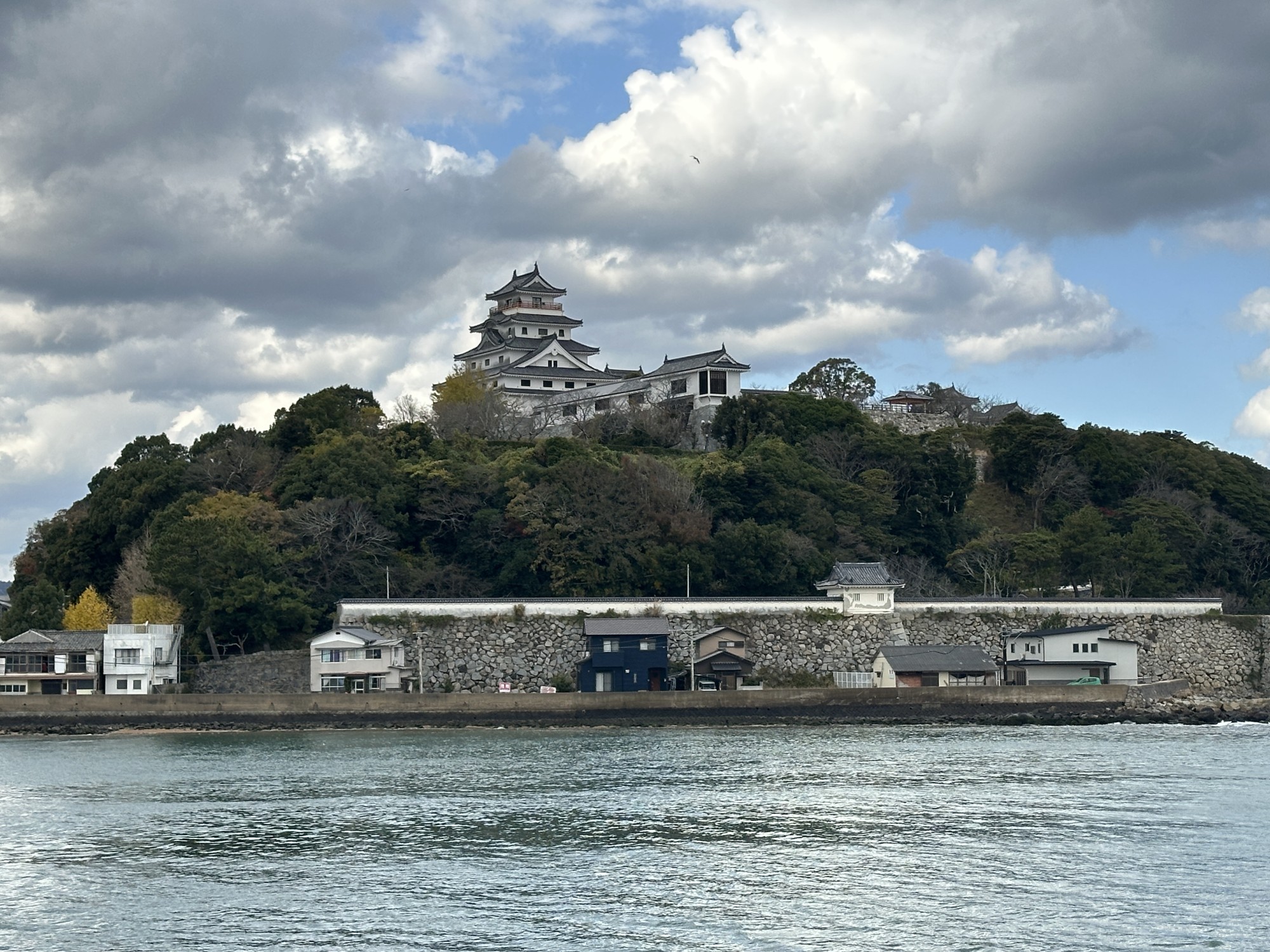
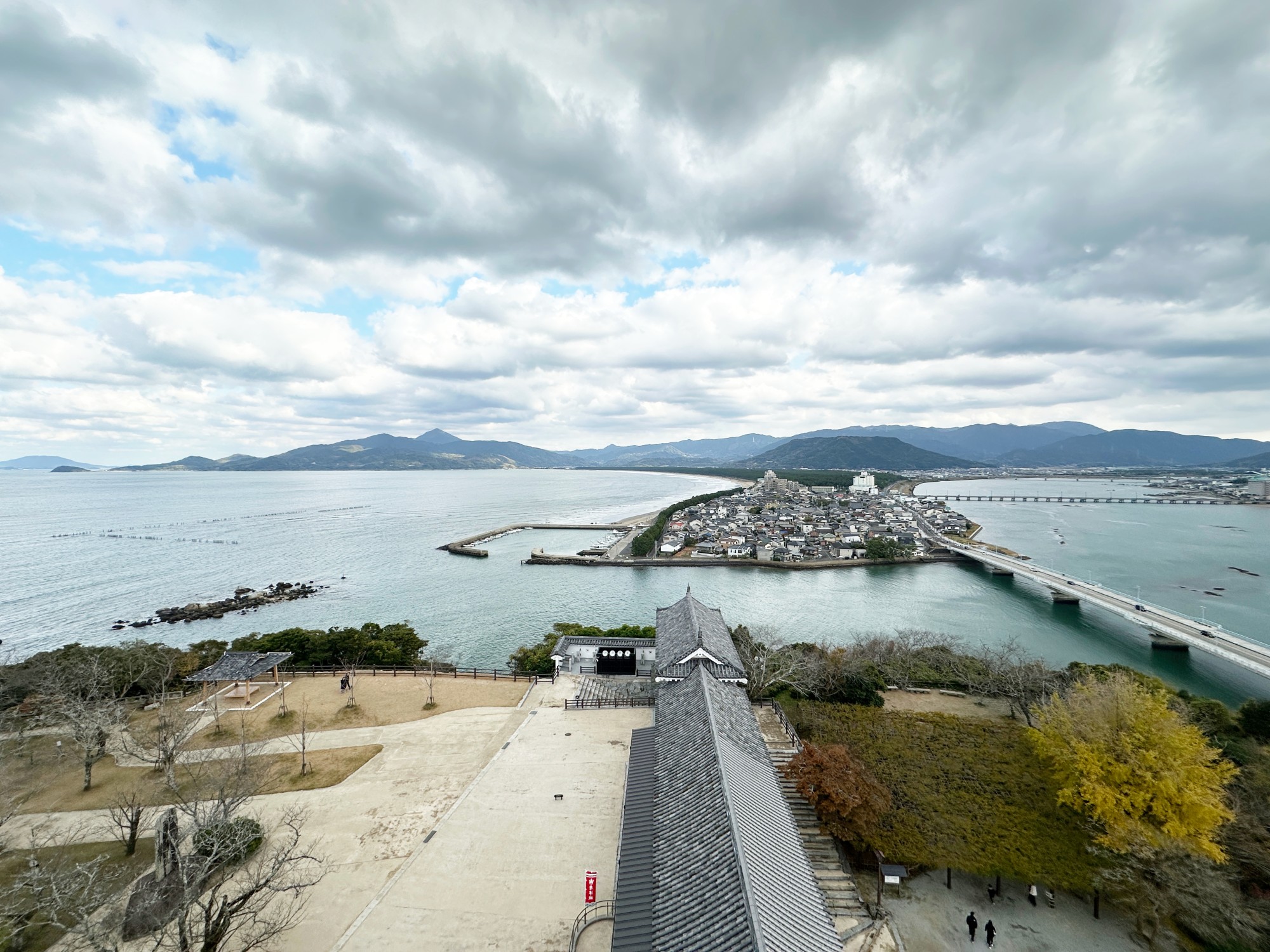
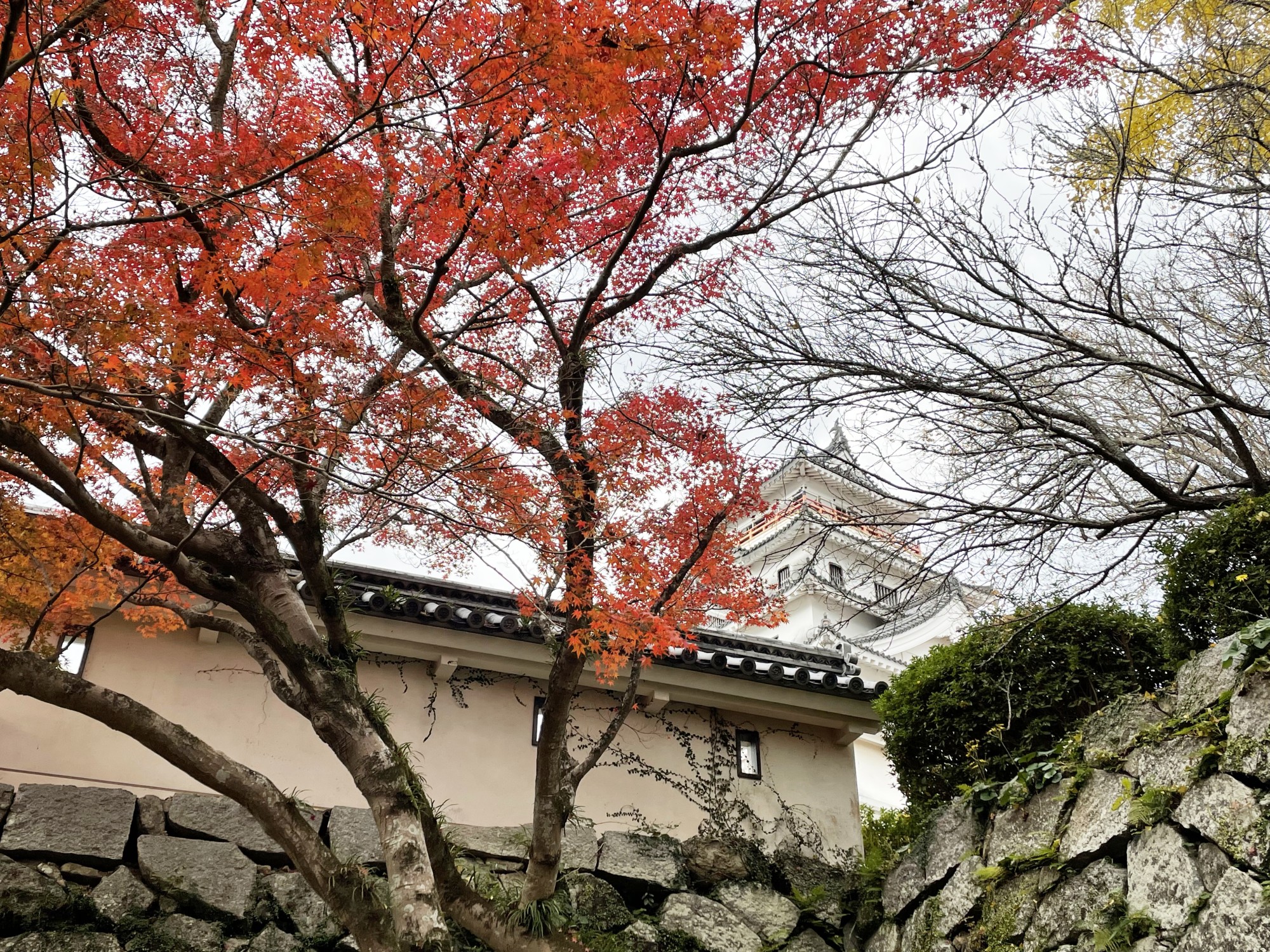
Soon Karatsu-jo, once the local daimyo lord's fortress residence, comes into view. It is set high on a hill with strategic views over the surrounding seas and Karatsu, the town where we spend the night. Whilst many walk up to the castle we also have the option of an elevator to whisk us to the entrance of the tenshukaku castle keep. From hereon, exploration of the multi-storey interior is only possible by foot. However, it is well worth the effort for the displays on Karatsu's samurai history and towering views over the surrounding countryside and seas.
Lunch, at a restaurant nearby, is followed by a stroll through this charming town. We visit the remarkable Takatori Residence, the former home of a coal tycoon completed in 1905 that combines traditional Japanese and the most up-to-date western architecture of its day. Much makes this building special but the ingenious Noh theatre stage is most extraordinary.
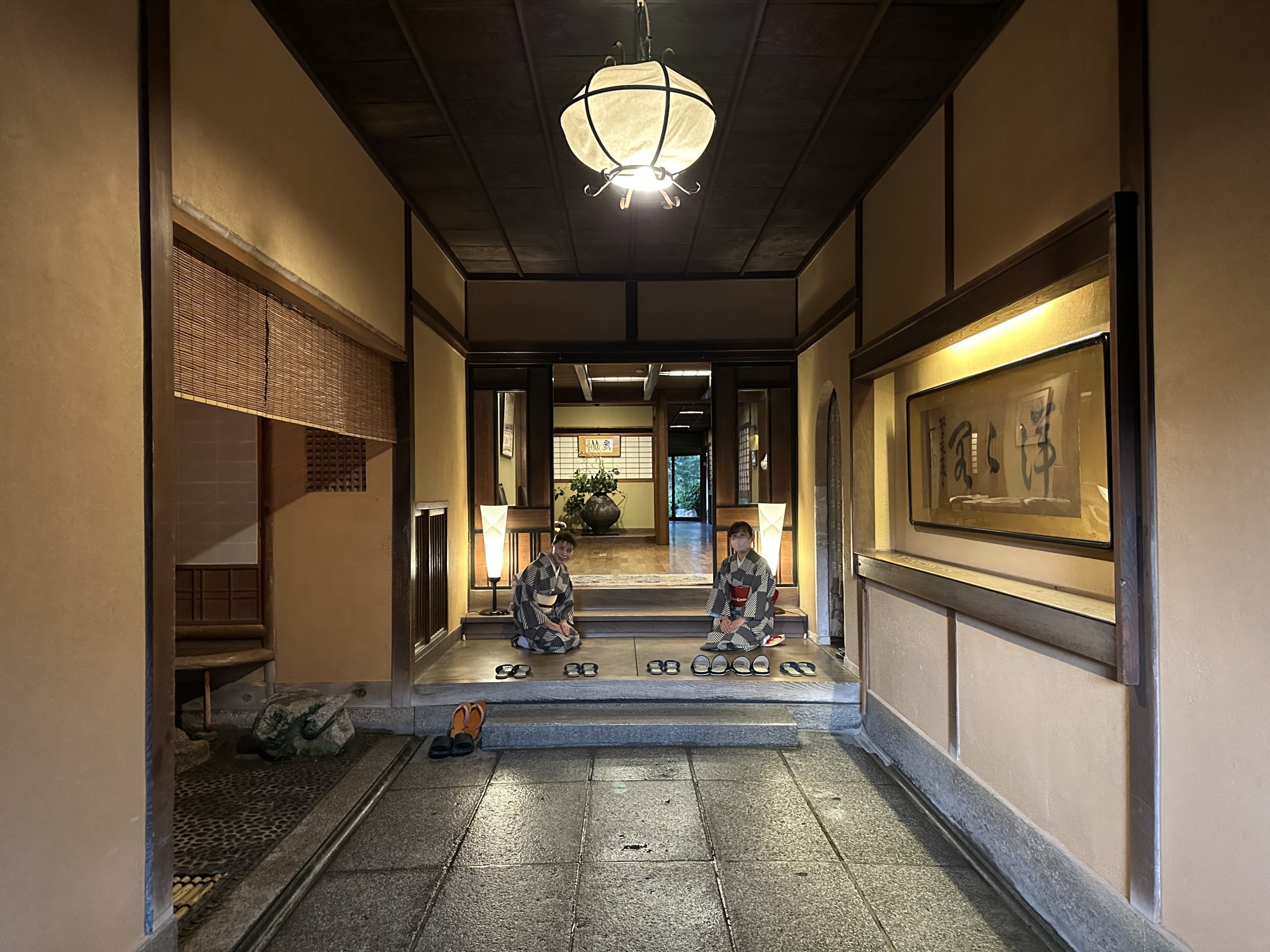
We continue our stroll through the town before making our way to our accommodation for the evening at one of Japan's top inns, a seaside oasis that Jacques Mayol, the French free diver and subject of Luc Besson's 1988 film The Big Blue, held close to his heart. Mayol was born in Shanghai in 1927 and spent summers with his family in Karatsu where he learnt to swim as a child.
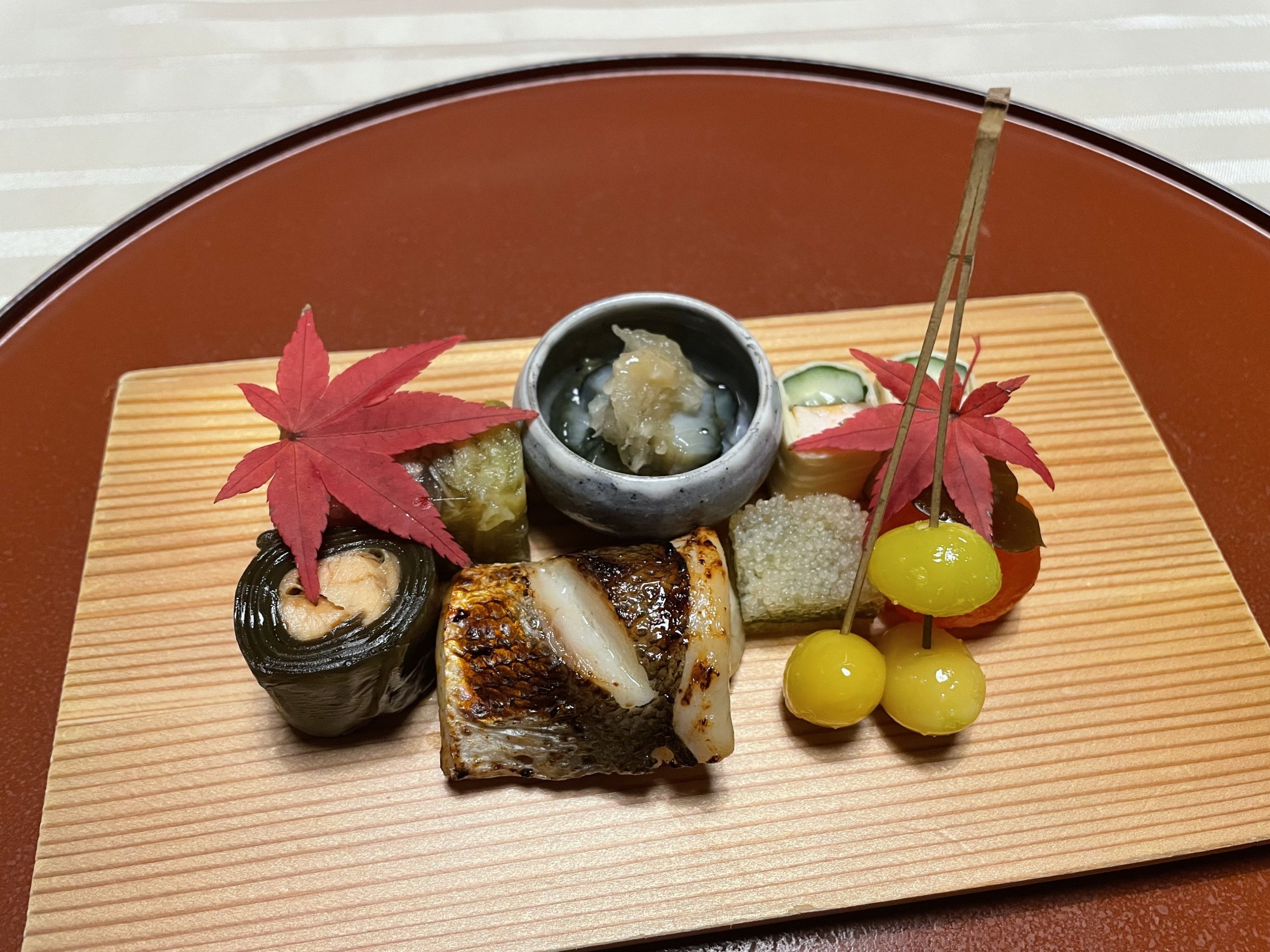
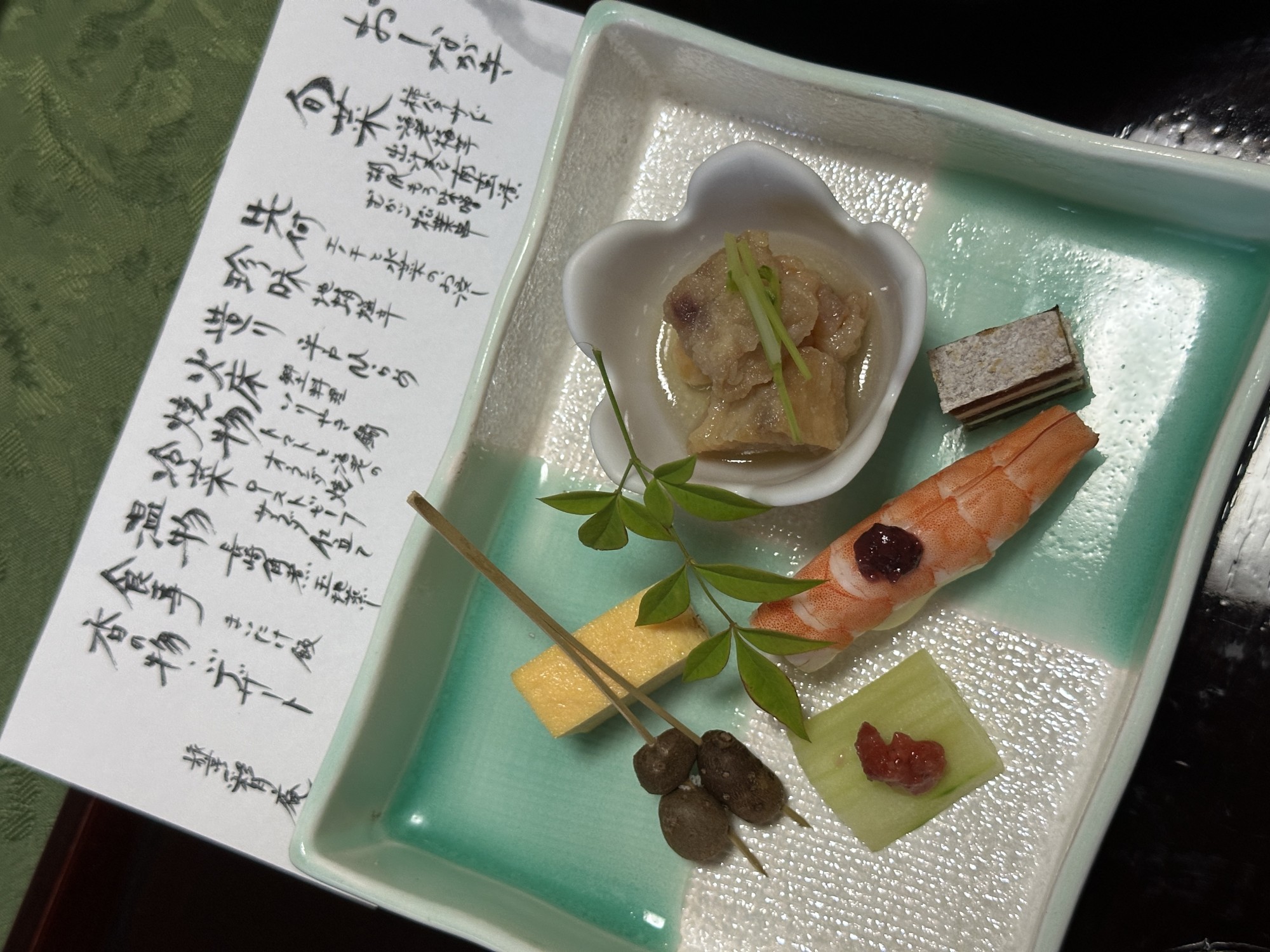
Our hosts' warm and helpful hospitality is complemented by excellent cuisine. The inn also incorporates two galleries, where we begin our exploration of the region's famed ceramics.
Accommodation: Traditional Japanese inn.
Meals: Breakfast, lunch & dinner provided.
Total walking: 9.4km (5.8 miles).
Total elevation gain: 68m (223ft).
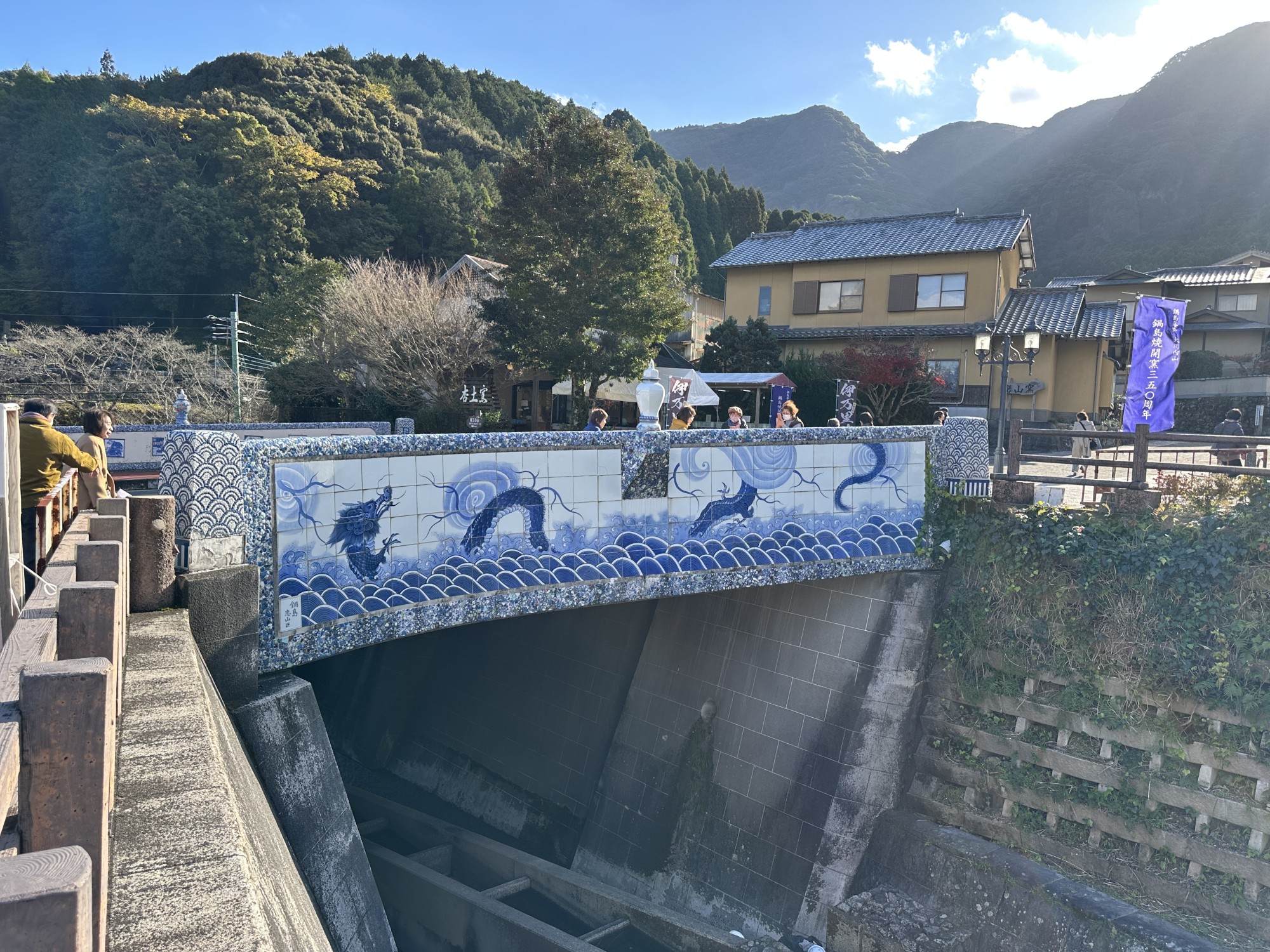
In Japan, Saga and porcelain are synonymous and a major subject of our tour today. After a hearty Japanese breakfast, we board a private-hire vehicle for an exploration of how the ceramics industry came to be established here in the 17th Century, its jealously guarded secret, its importance in trade with Europe, and how it thrives to this day. We first visit Okawachi-yama, a quiet pretty village at the top end of a small valley. Although it is still known for its ceramics, little suggests that this was once the closely guarded epicentre of Japan's porcelain industry 350 years ago. Heavily guarded gates once prevented interlopers intent on uncovering the mystery to porcelain production. We gently stroll around the quiet streets lined with galleries and cafes. We also visit the memorial to the Korean potters whose skills were fundamental to establishing the Japanese porcelain arts.
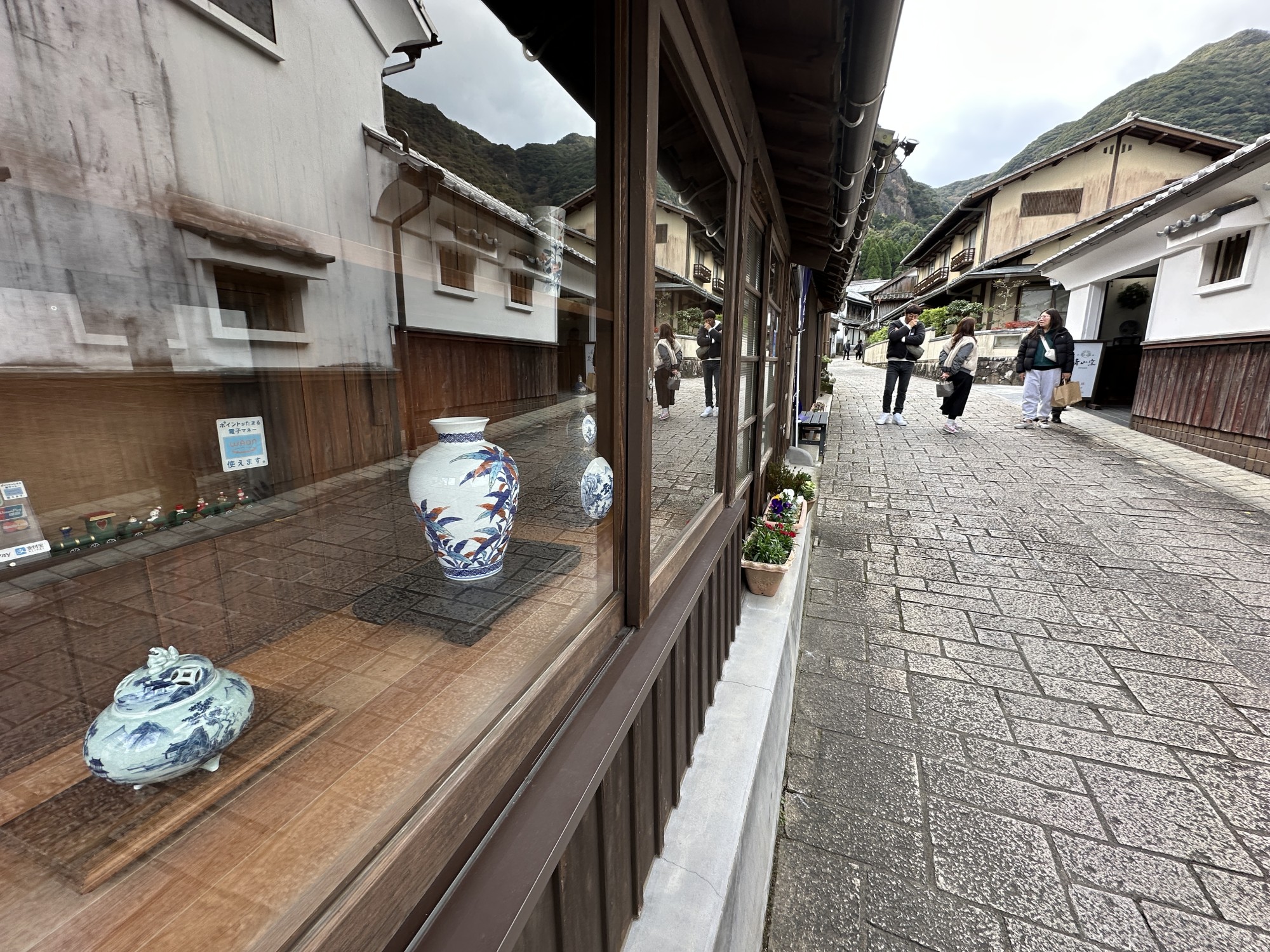
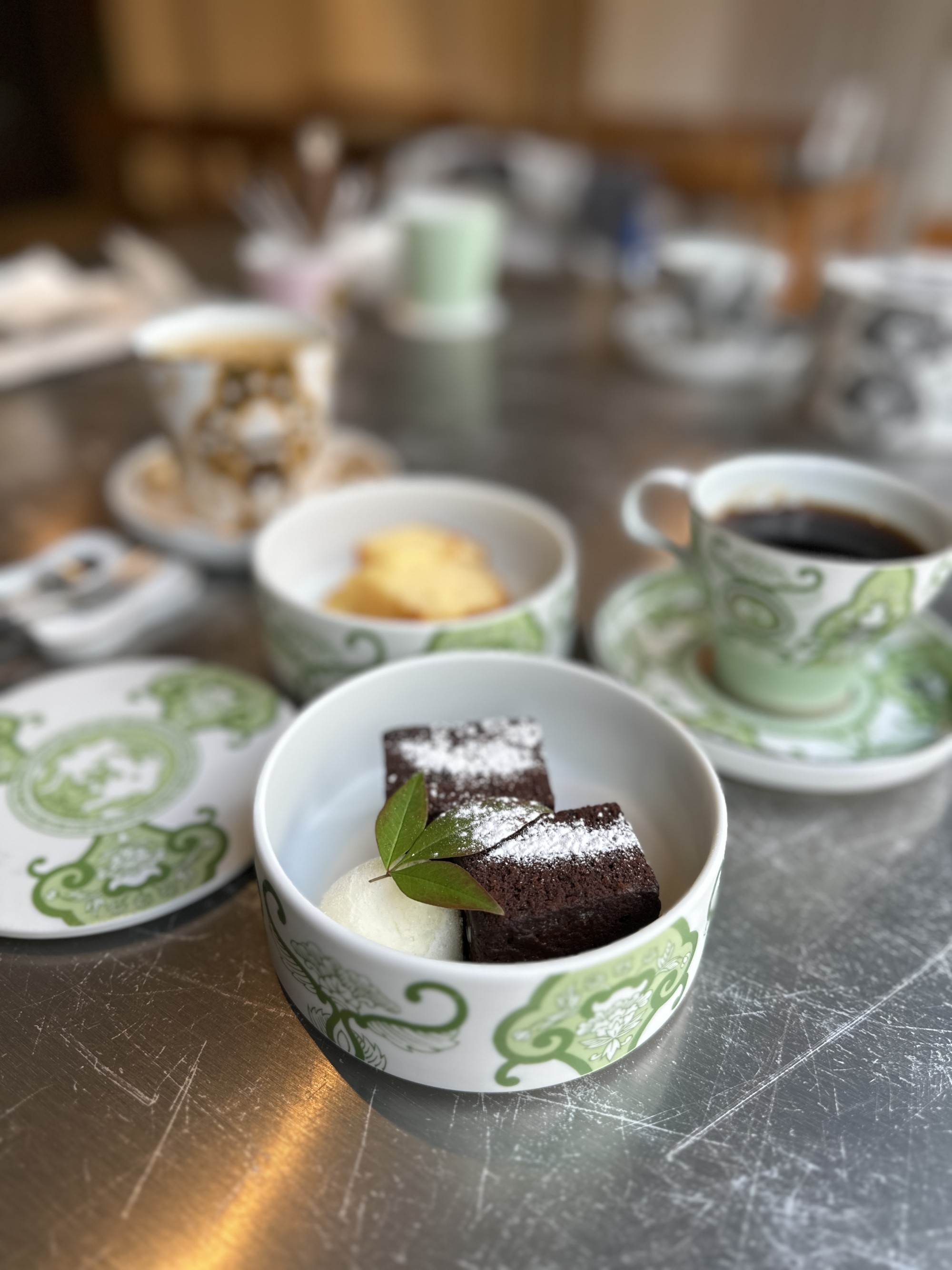
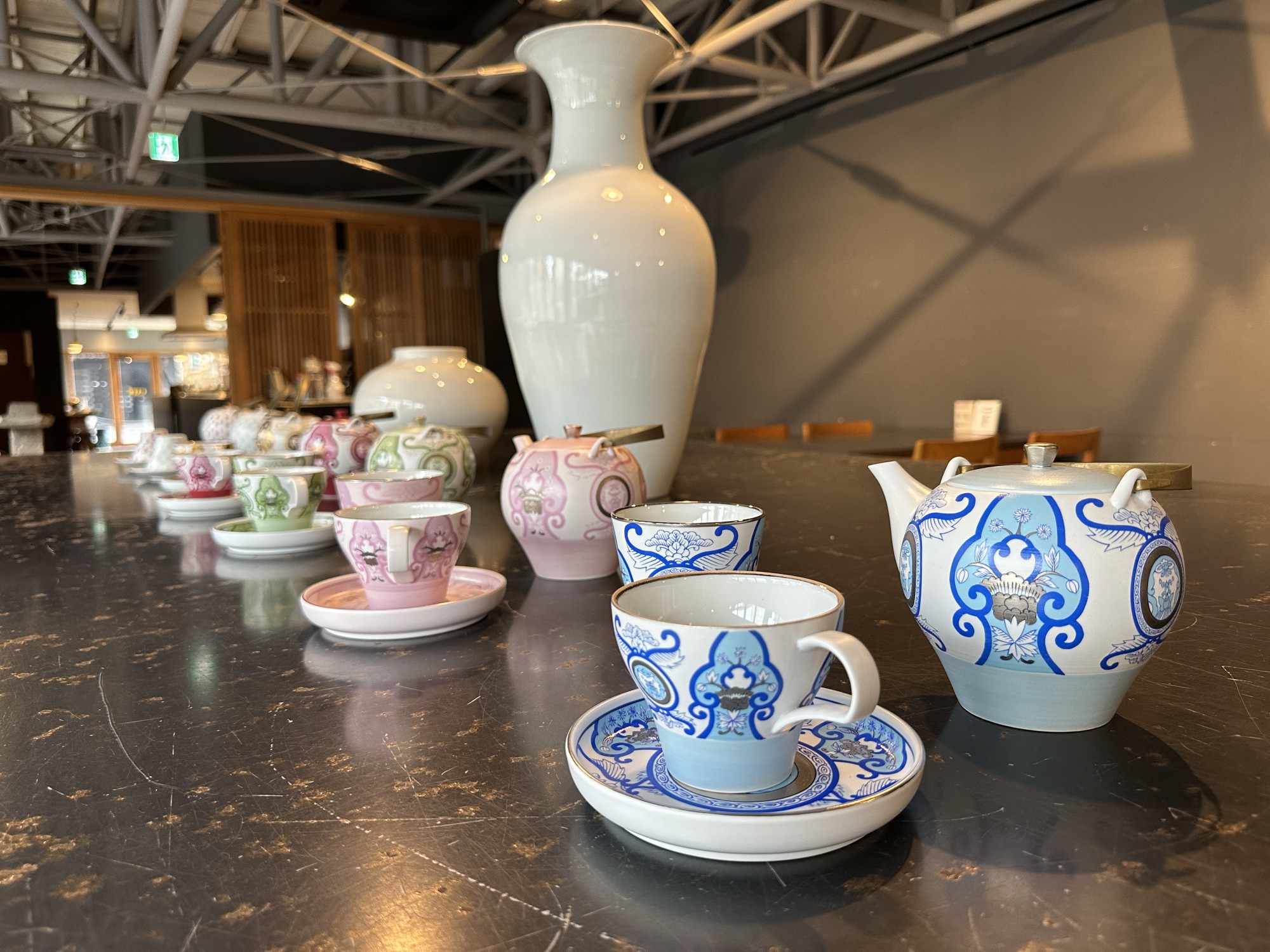
In time, the secret was divulged and ceramic production spread to neighbouring towns including Arita, which has long been considered the epitome of Saga's porcelain. A short drive brings us to this unassuming town. It came to prominence because of the secret ingredient found here in abundance, kaolin, a whiteish, soft earthy deposit. We visit its kaolin workings before strolling through the town, which houses a wide variety of Arita ware, from the traditional to the avant garde, in colourful galleries and chic cafes.
Today, lunch is not included in the tour as Arita offers a variety of restaurants to enjoy at your leisure. Your Tour Leader will advise on where you might like to eat and help settle you in. They will also recommend the best galleries and other sites to visit at your leisure for an hour or so after dining.
This evening, our accommodation is a modern Japanese inn with onsen hot spring baths set high above a valley. The inn is quintessential Japanese modern architecture of the late 20th Century. It was designed by Kisho Kurokawa, a top Japanese architect who also created the Central Plaza 1 in Brisbane, Lane Crawford Place and Republic Plaza in Singapore and the National Arts Center and Nakagin Capsule Hotel in Tokyo amongst many other landmarks around the world. His Metabolist Movement architecture is a striking contrast to Saga's traditional ceramics.
Our accommodation's onsen baths provide us with gentle relaxation and expansive views overlooking the valley below. Afterwards, we enjoy a beautifully presented dinner together while your Tour Leader describes Japan's porcelain and Japan's wider pottery culture in greater detail.
Accommodation: Onsen hot spring resort.
Meals: Breakfast & dinner provided.
Total walking: 3.3km (2 miles).
Total elevation gain: 30m (98ft).
Although we have an early start today, do make sure to begin the day with an early morning dip in the onsen baths. Today, we are headed for Hirado, an unusual name for an unusual port town on an island at one of the furthest western extents of Japan. The Portuguese, who were the first Europeans to reach Japan in 1543 made their base here and named it Firando, which was subsequently interpreted by the Japanese into its current appellation.
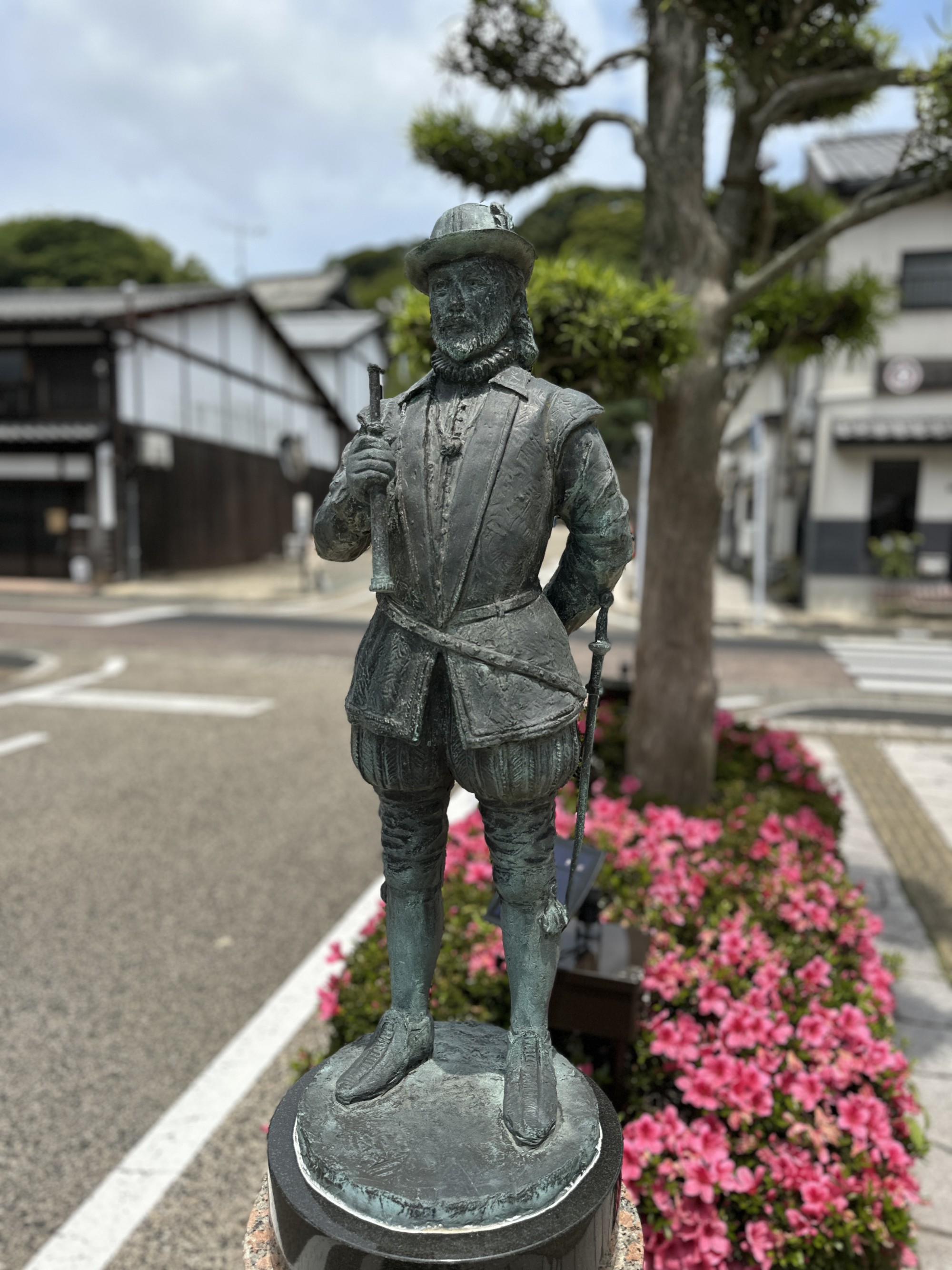
Hirado is far from much of the rest of Japan but for a short while during the late 16th and early 17th Centuries it held a central role in Japan's relations with Europe. After the Portuguese had left to establish trading further south at a small village, subsequently to become Nagasaki, the Dutch followed, along with William Adams (1564 - 1620), an Englishman whose extraordinary life is the inspiration for James Clavells' best selling novel Shogun and its subsequent hit Hollywood series starring Cosmo Jarvis as the eponymous hero Blackthorne, a.k.a. Adams.
Our guided walking exploration takes us through this very attractive quiet seaside town on an enthralling journey into the earliest days of Europeans in Japan; of Portuguese Jesuits, the Dutch East Indies Company, William Adams' rise to high ranking samurai status and an ill-fated English attempt to trade with Japan. Our stroll includes visits to Hirado's wonderful museum housed in the family residence of the Matsuura daimyo lord, Japan's first ever stone bridge, reconstruction of the Dutch trading post, and memorials to the sailors and traders who risked life and limb to reach Japan over 400 years ago in pursuit of riches. Adams, who is known to this day in Japan as Miura Anjin, died here in 1620 and we pay our respects at his grave.
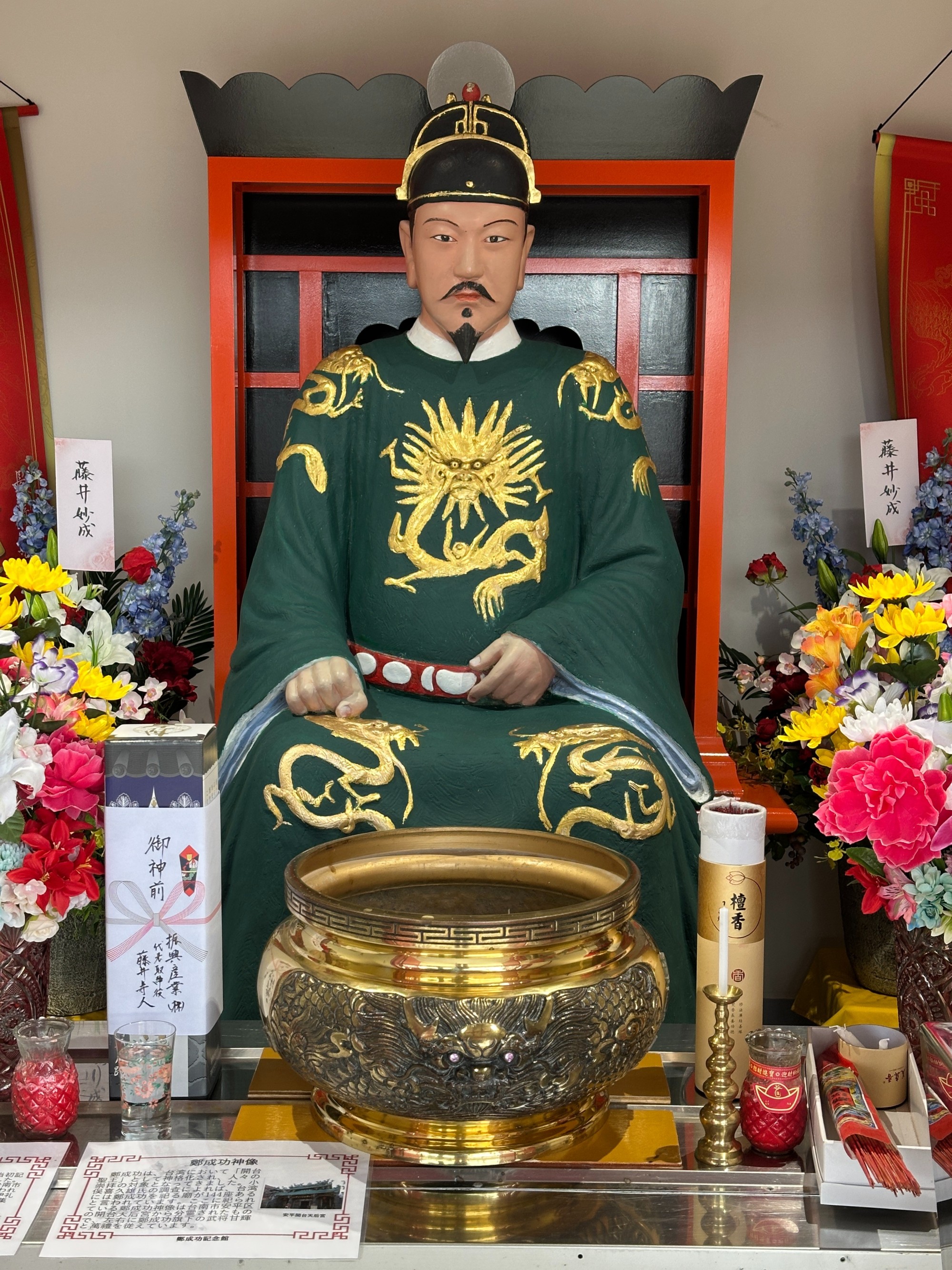
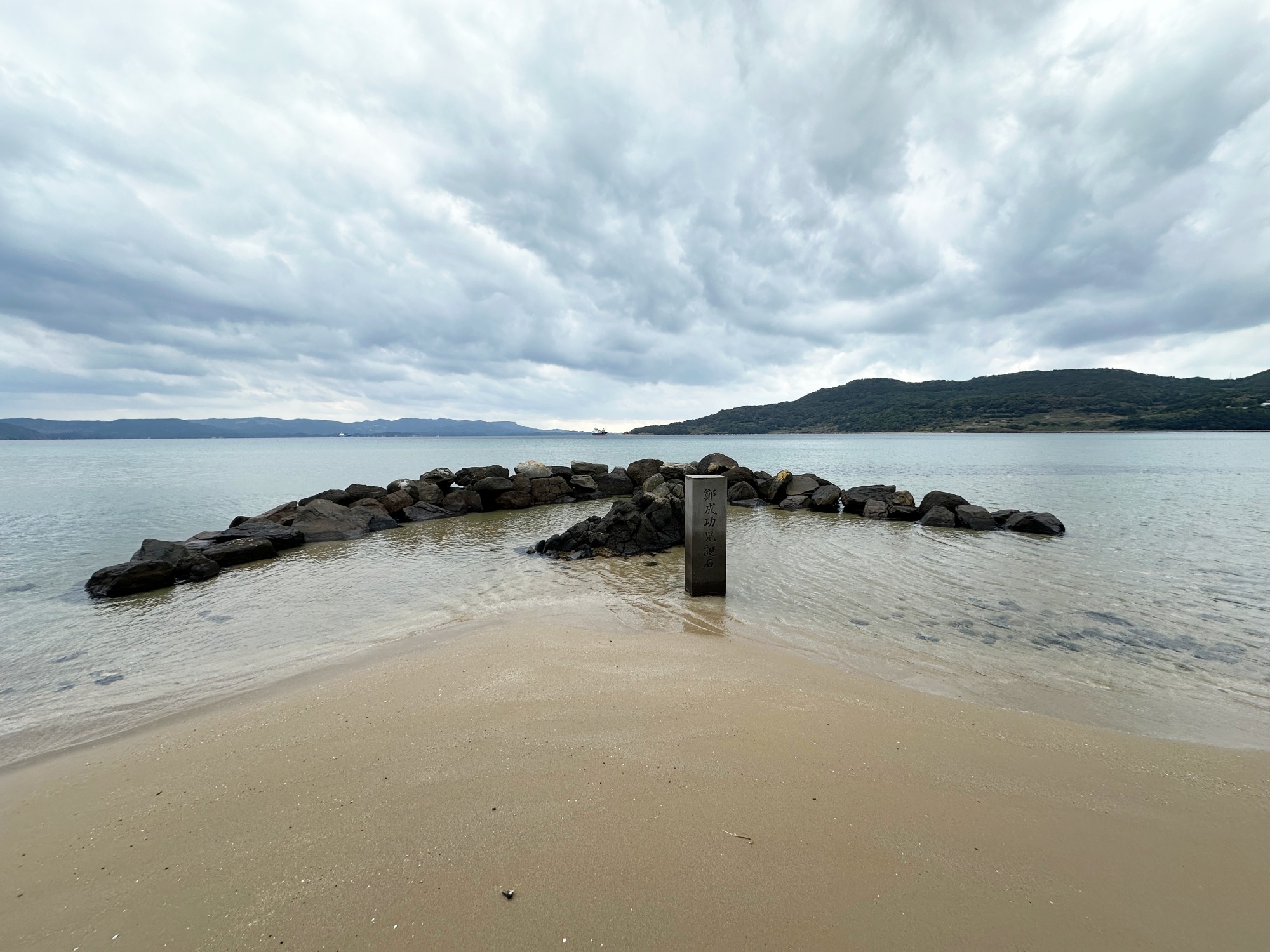
However, Hirado was not only frequented by Europeans. Chinese traders also found their way here and four years after Adams passed away Zheng Chenggong (1624-1662), also known as Koxinga, was born here to a Chinese merchant and Japanese lady. At the age of seven, Zheng moved to China and rose through the Ming imperial system on merit to become a general, lauded by the Chinese to this day, who resisted the Qing conquests of the 17th Century and drove the Dutch out of Taiwan.
After lunch, we visit the site of Zheng's birth on a beach and a shrine in his honour before exploring the lovely surrounding countryside of Hirado. Our accommodation for the evening is another onsen hot spring establishment.
Accommodation: Western-style hotel.
Meals: Breakfast, lunch & dinner provided.
Total walking: 4km (2.5 miles).
Total elevation gain: 68m (223ft).
Today, we delve a little further into porcelain, but this time at Hasami in Nagasaki Prefecture. Hasami has been a centre of ceramics production for over four hundred years but its work was long subsumed by its powerful neighbour Arita. Our particular interest is in its recently renewed independence and revival as a centre of contemporary ceramics.
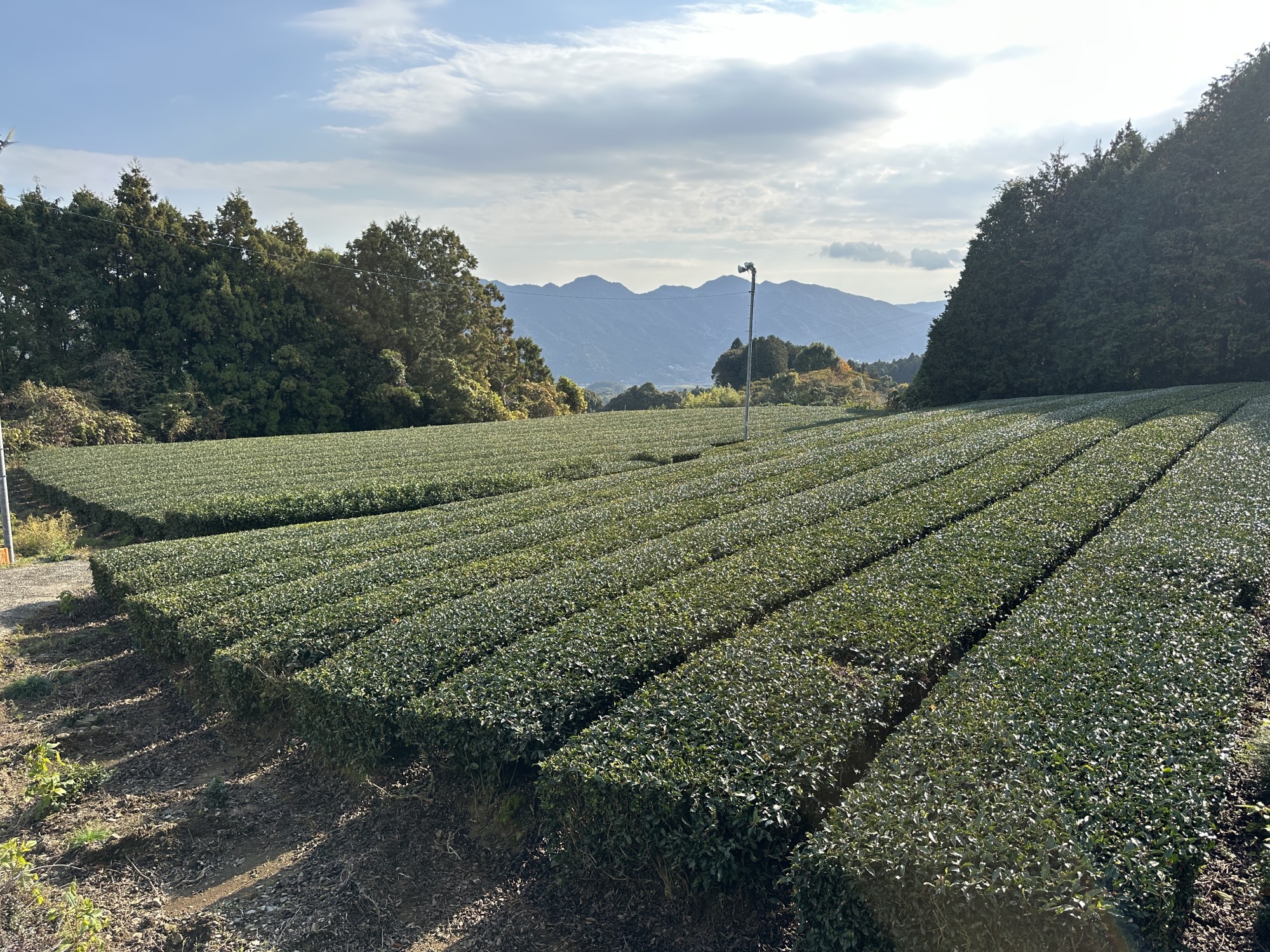
Nearby is Ureshino, one of Japan's top onsen towns that is particularly known for its soft bihada waters that leave skin beautifully radiant. It is also known as a centre of tea cultivation and we spend the day, literally, immersed in every Japanese persons' favourite non-alcoholic beverage. We learn how tea is produced, perfectly brewed and imbibed, the significance of the chado tea ceremony and inextricable relationship with Japan's ceramics.
Ureshino was a post town, a stopping point on the Nagasaki Kaido, one of Japan's historic thoroughfares that samurai and Dutch traders alike walked to pay their respects to the shogun in far-flung Edo, modern-day Tokyo. The onsen here really are heavenly and we follow in the footsteps of the many travellers who have luxuriated here over the centuries. Our accommodation provides wonderful hot spring bathing and cuisine with green tea themes.
Accommodation: Onsen hot spring resort.
Meals: Breakfast, lunch & dinner provided.
Total walking: 5km (3.1 miles).
Total elevation gain: 76m (249ft).
After sending our main luggage ahead of us, we catch the West Kyushu Shinkansen bullet train to Nagasaki. However, we will not be sitting down for long as these high speed trains reach speeds of up to 260km per hour and, at only 66km in total length, it is the shortest bullet train line in Japan.
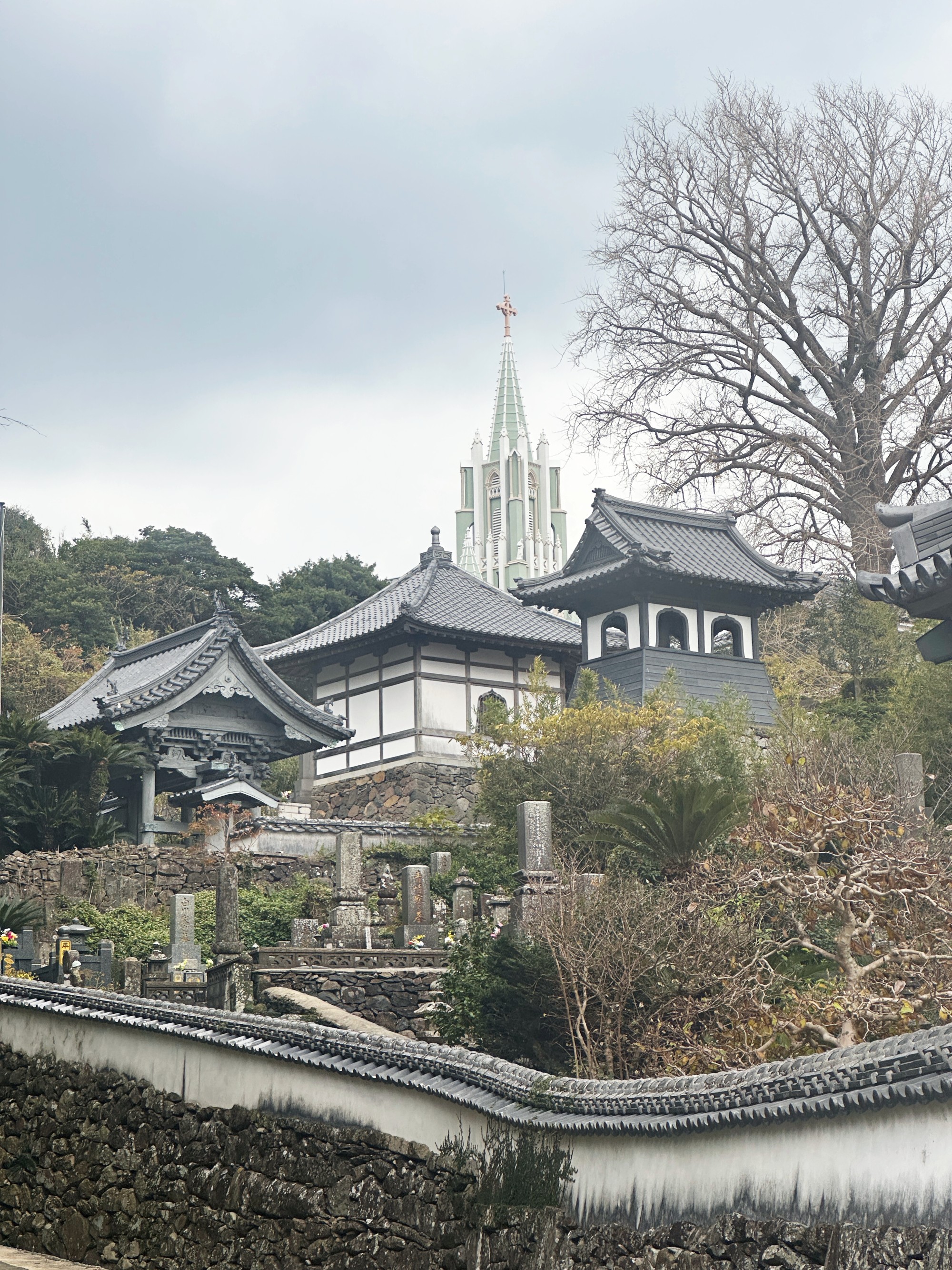
Nagasaki is one of Japan's most intriguing cities. The Portuguese convinced the local daimyo lord that they should establish a trading post, which subsequently became Japan's sole conduit to the rest of the world for over two hundred years, a multi-cultural nexus of Japanese, Westerners and Chinese, centre of Christianity, and notorious as the target of the second atomic bomb.
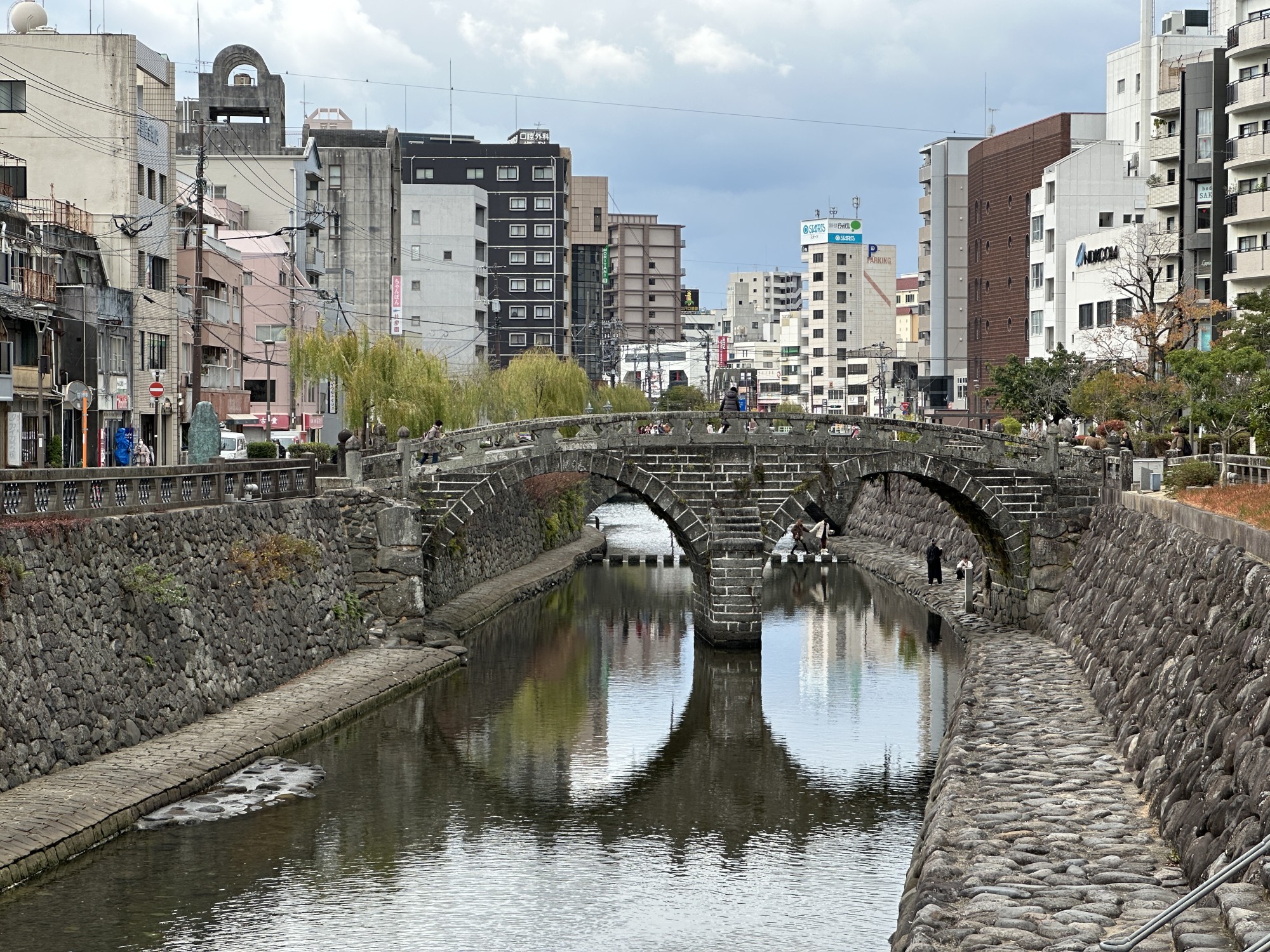
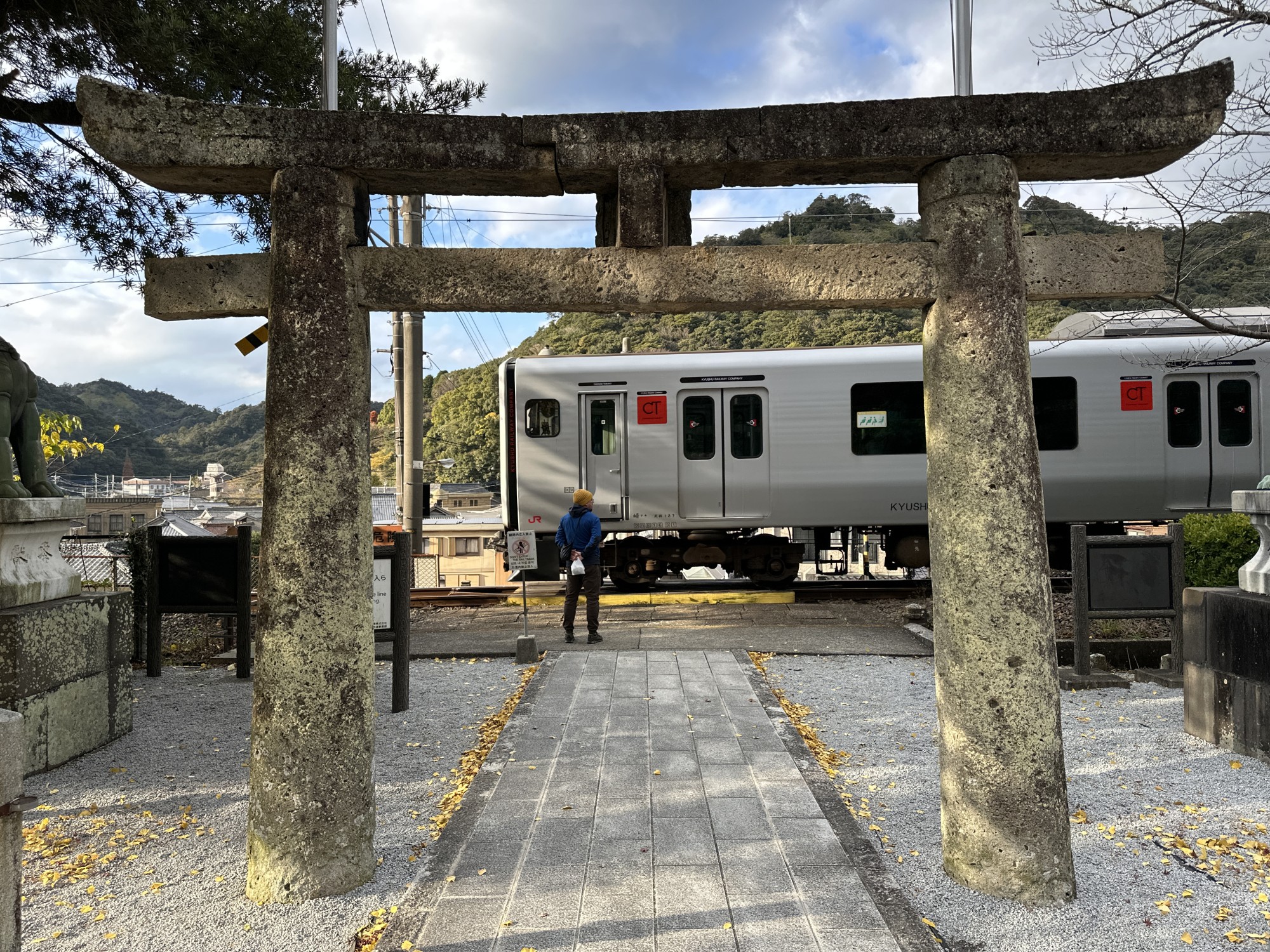
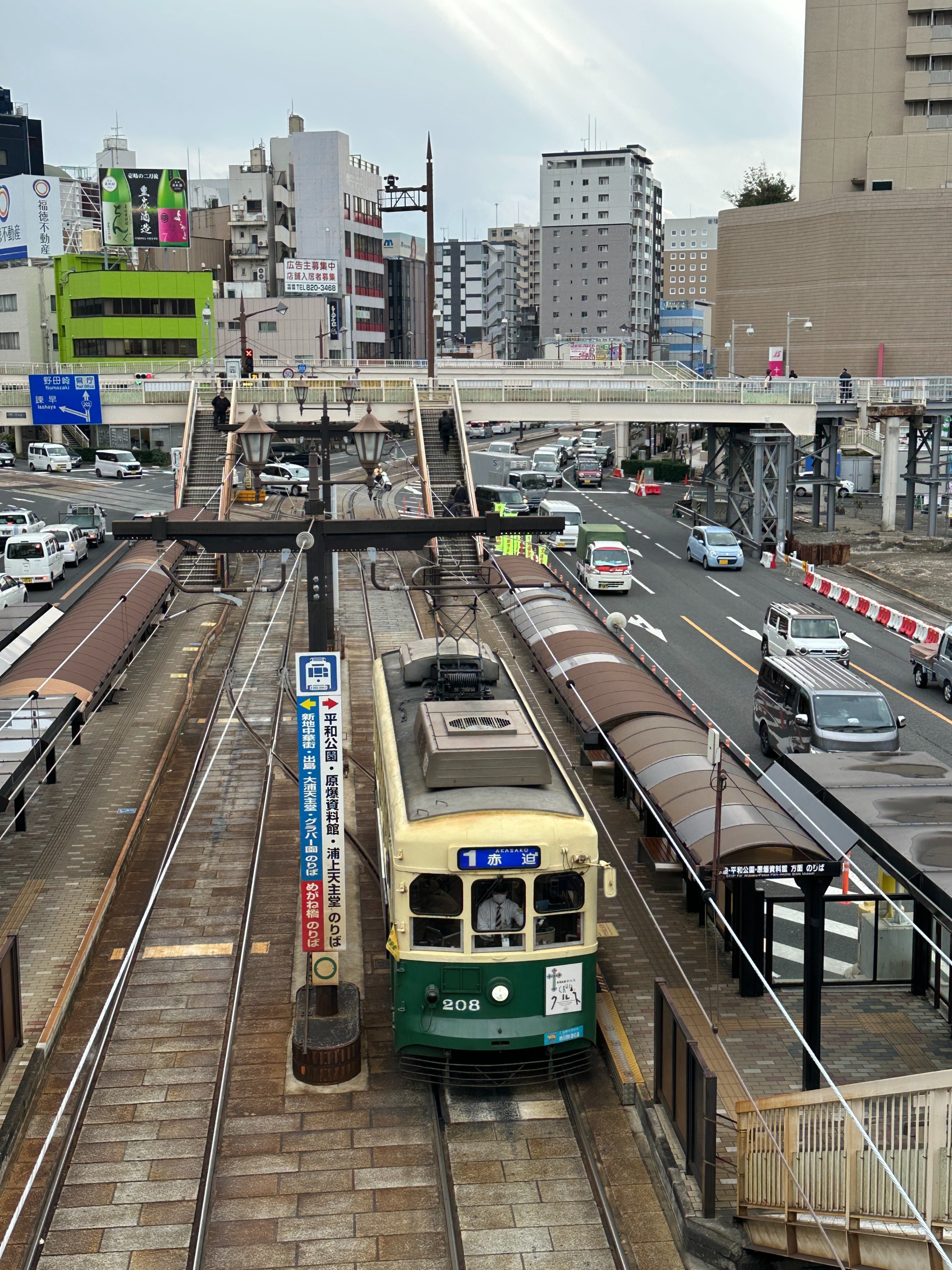
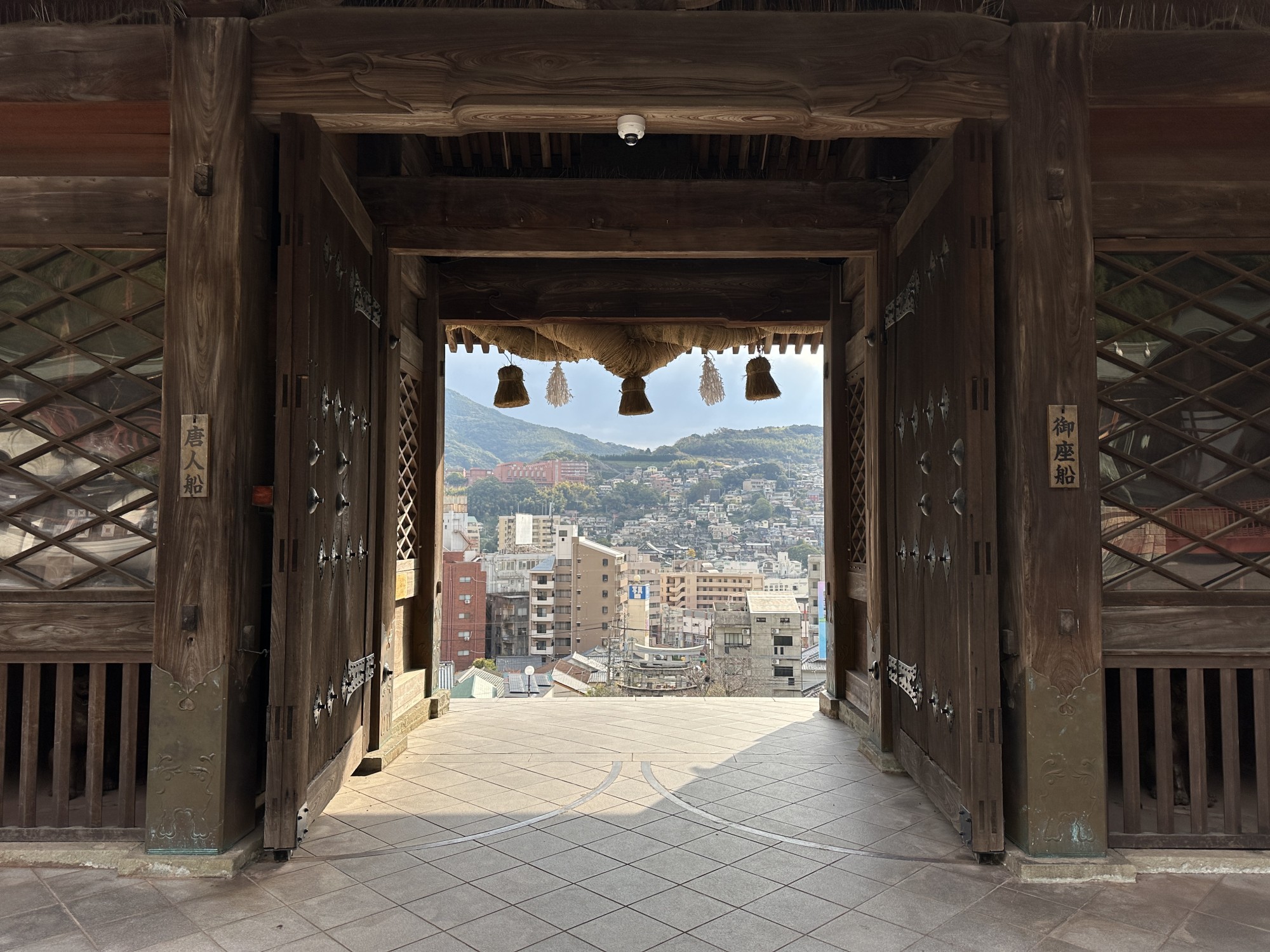
From high speed transport we transfer to sedate trams to begin our exploration of Nagasaki. This takes us via historic Shinto shrines and Japanese and Chinese temples; wrought stone bridges; a memorial to Puccini and his opera Madam Butterfly that has its roots in the city; Thomas Glover a Scotsman who was instrumental in developing Japan's industrial might and a famous brewery in the late 19th Century; and grandstand vistas across Nagasaki. En route, we enjoy lunch together in Nagasaki’s famed China Town.
Our accommodation is near Shianbashi, Nagasaki's vibrant nightlife district, where we venture out together for our evening meal. Those who wish to explore further after dining will easily find a warm welcome in one of many bars frequented by Japanese and overseas visitors alike, much as happened here over the centuries.
Accommodation: Western-style hotel.
Meals: Breakfast, lunch & dinner provided.
Total walking: 4.8km (3 miles).
Total elevation gain: 78m (256ft).
Nagasaki has so much to offer that we spend two nights in the city to try and make the most of it. This morning, we visit Dejima, a crescent-shaped manmade island that housed first the Portuguese and, after they were expelled from Japan, then Dutch traders who were moved here from Hirado. From 1641 until the 1860s, when western powers flexed their seafaring and military prowess that eventually caused the fall of the shogunate and end of the samurai Edo Period (1603-1868), this tiny island was the only opening between the west and Japan under pain of death. Besides trade, Dejima was also the source of rangaku, literally Dutch studies of the western sciences, technologies and medicine of the day.
Dejima has largely been recreated and provides fascinating insights into Edo Japan and the west, trade, culture, intrigue and the sheer boredom of the Dutch traders who usually had little to do except when a sole trading galleon made its annual visit and entered port.
The rest of the day is free for everyone to explore Nagasaki, which has a very convenient public transport system, is well-versed in English and has a myriad other sites of interest including the Peace Park and Museum, Nagasaki Prefectural Art Museum designed by Tokyo Olympic Stadium architect Kengo Kuma, and Gunkanjima, an abandoned mining town that covers a small island and which features in the James Bond movie Skyfall.
Your Tour Leader will advise on how you may best use your time, and where to enjoy lunch and dinner.
Accommodation: Western-style hotel with onsen hot spring baths.
Meals: Breakfast provided.
Total walking: 4km (2.5 miles).
Total elevation gain: 85m (279ft).
After breakfast, we board a private-hire vehicle for our journey south to the Shimabara Peninsula. We follow the peninsula's western coast which affords us views across the shimmering East China Sea. Obama Onsen, a seaside resort and our initial destination today, is reputed to be the source of the highest temperature hot spring waters, at up to 105 degrees centigrade, in Japan.
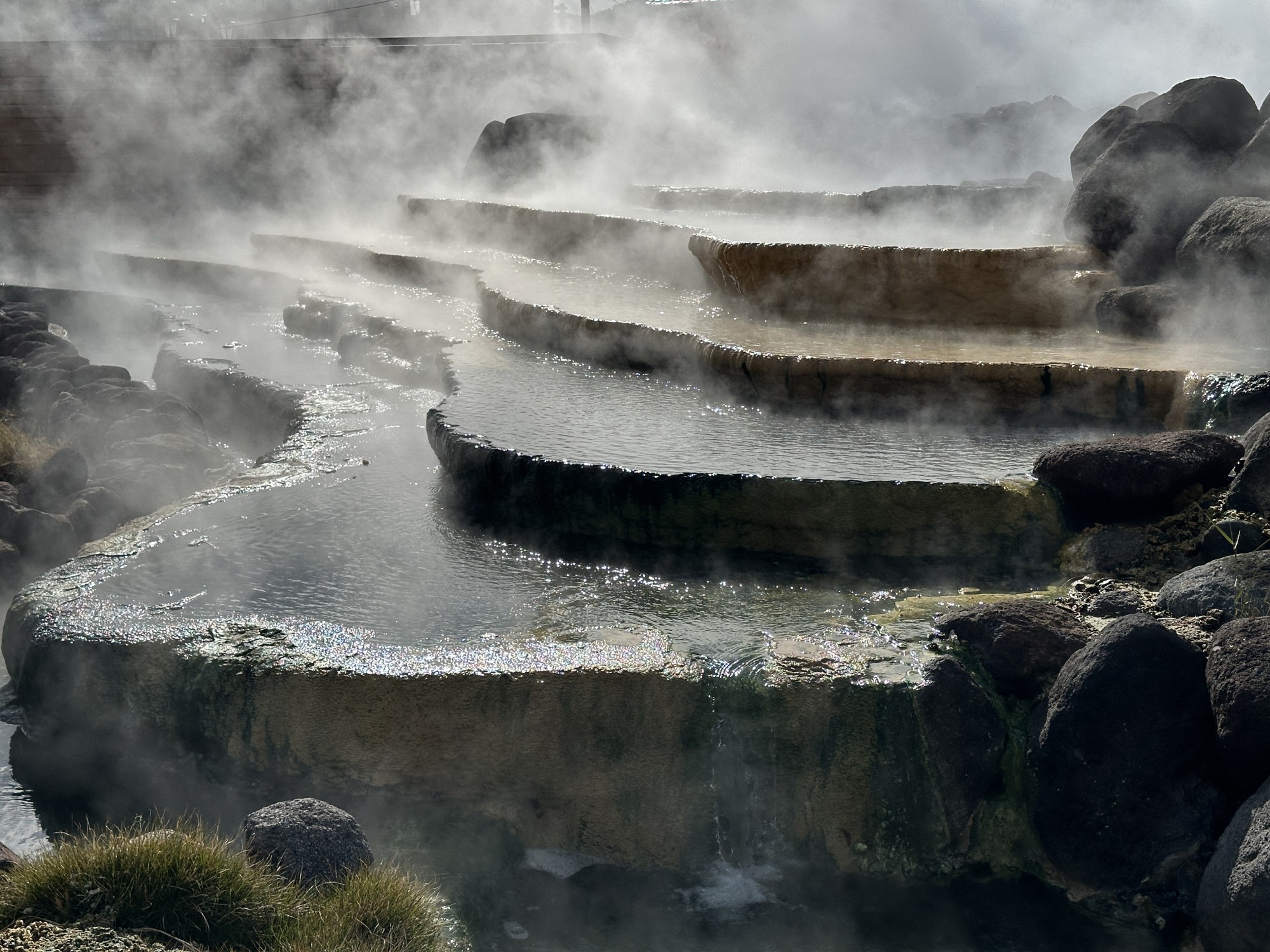
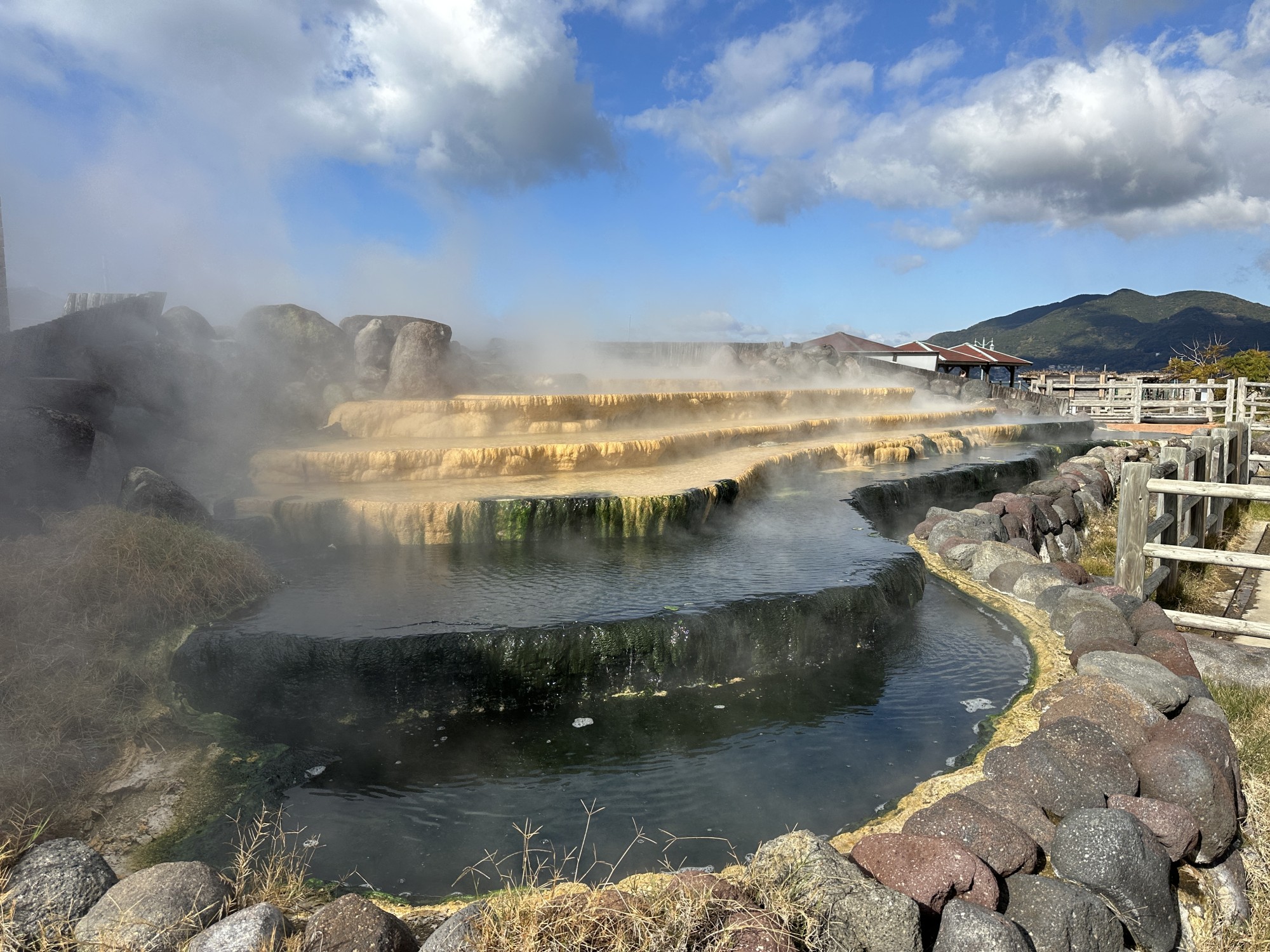
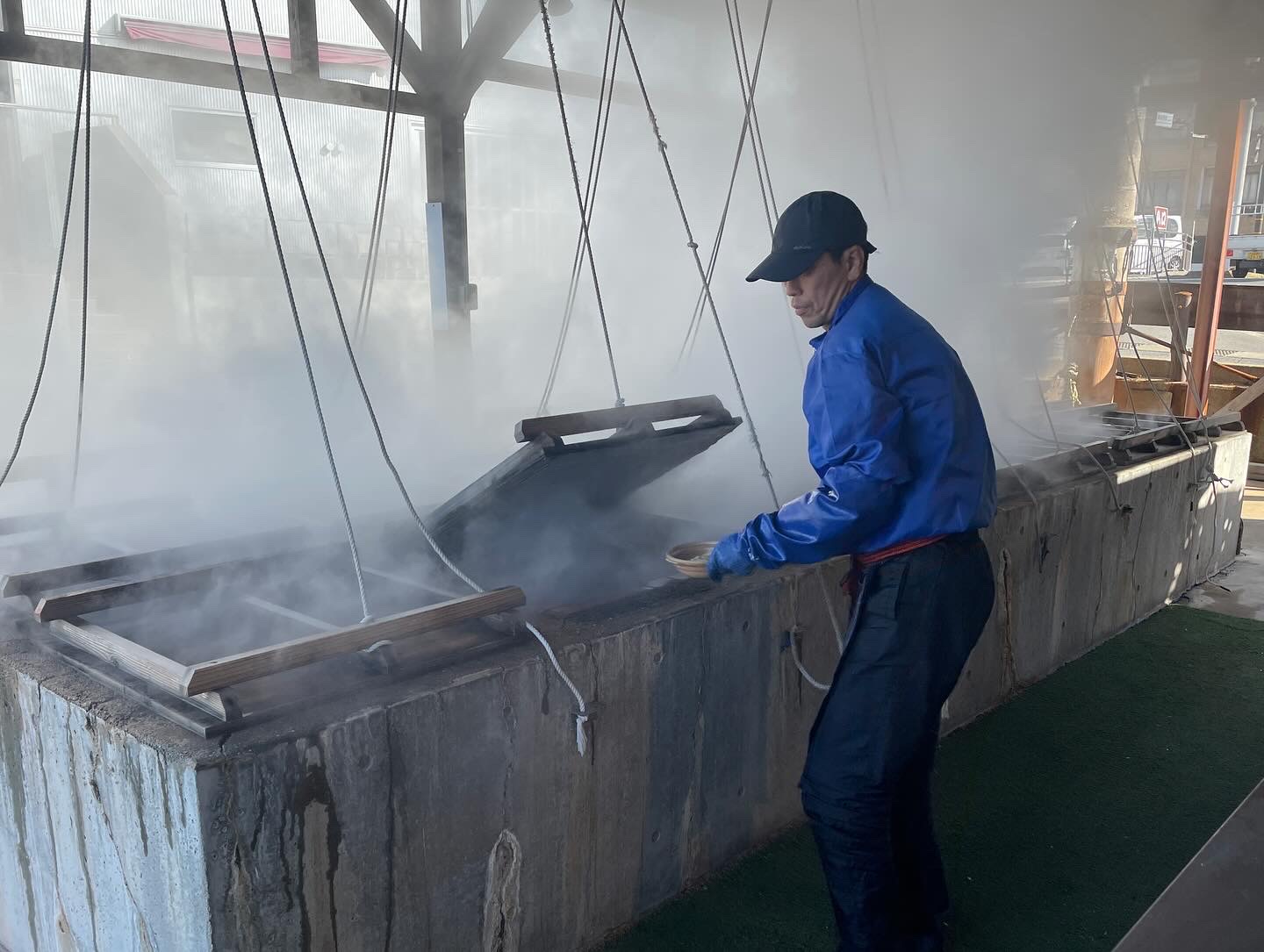
Obama is at the foot of Mt. Unzen, one of Japan's more active volcanic regions and the source of the hot spring waters. Wherever we wander on our stroll around town together we come across steam emanating from the ground. Even the restaurant where we enjoy lunch uses onsen waters to steam our dishes of seafood, meats and vegetables to perfection.
After leaving Obama, we quickly climb in our vehicle to Unzen Onsen. In common with Obama, Unzen was founded on its plentiful supply of onsen waters for therapeutic and leisure pursuits and was a popular summer retreat for westerners living in Shanghai and the wider Far East until the late 1930s. It is no surprise, perhaps, to then learn that Japan's second ever golf course and its first public one, a links, was founded here in 1913 and is still popular to this day.
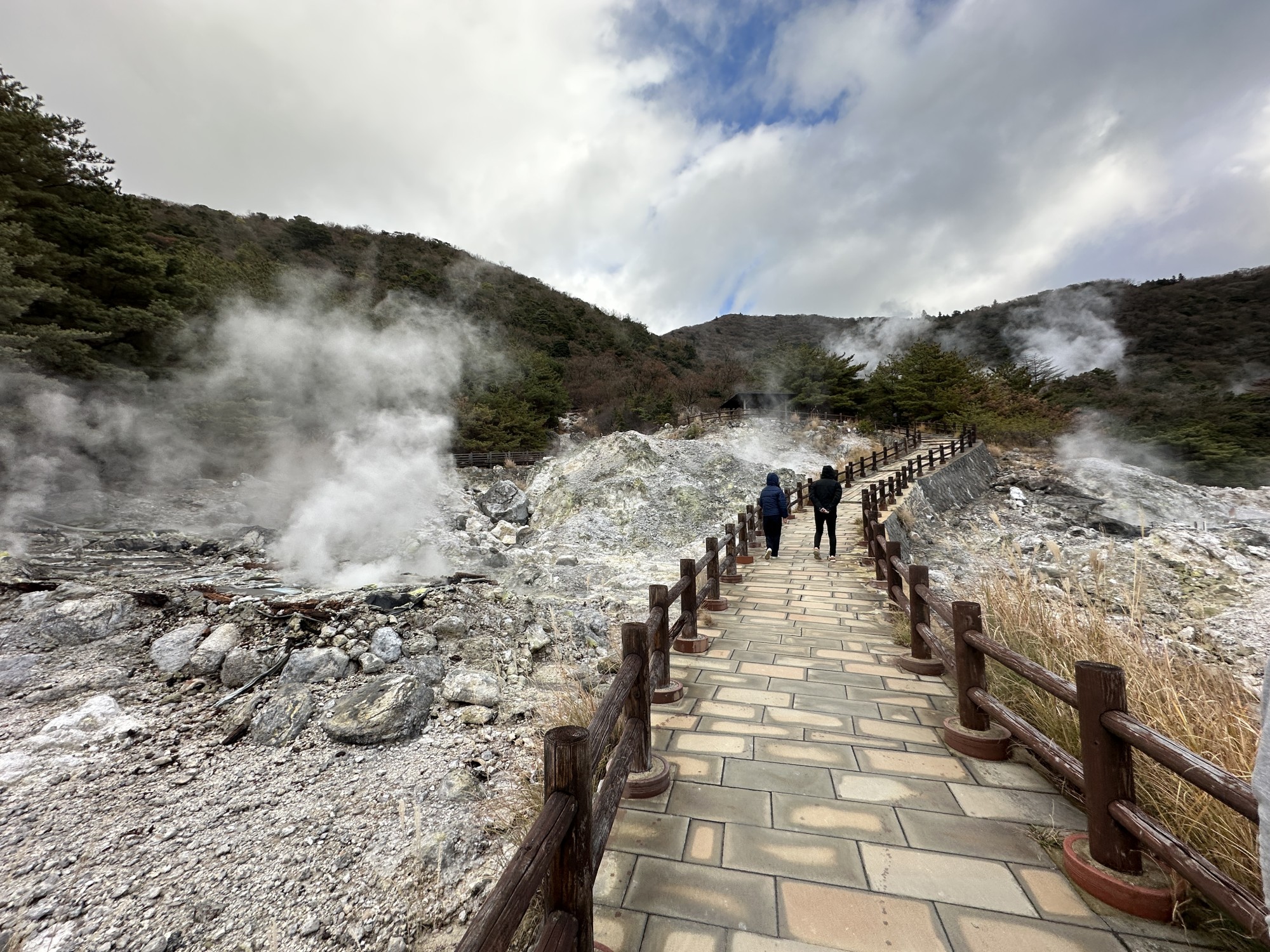
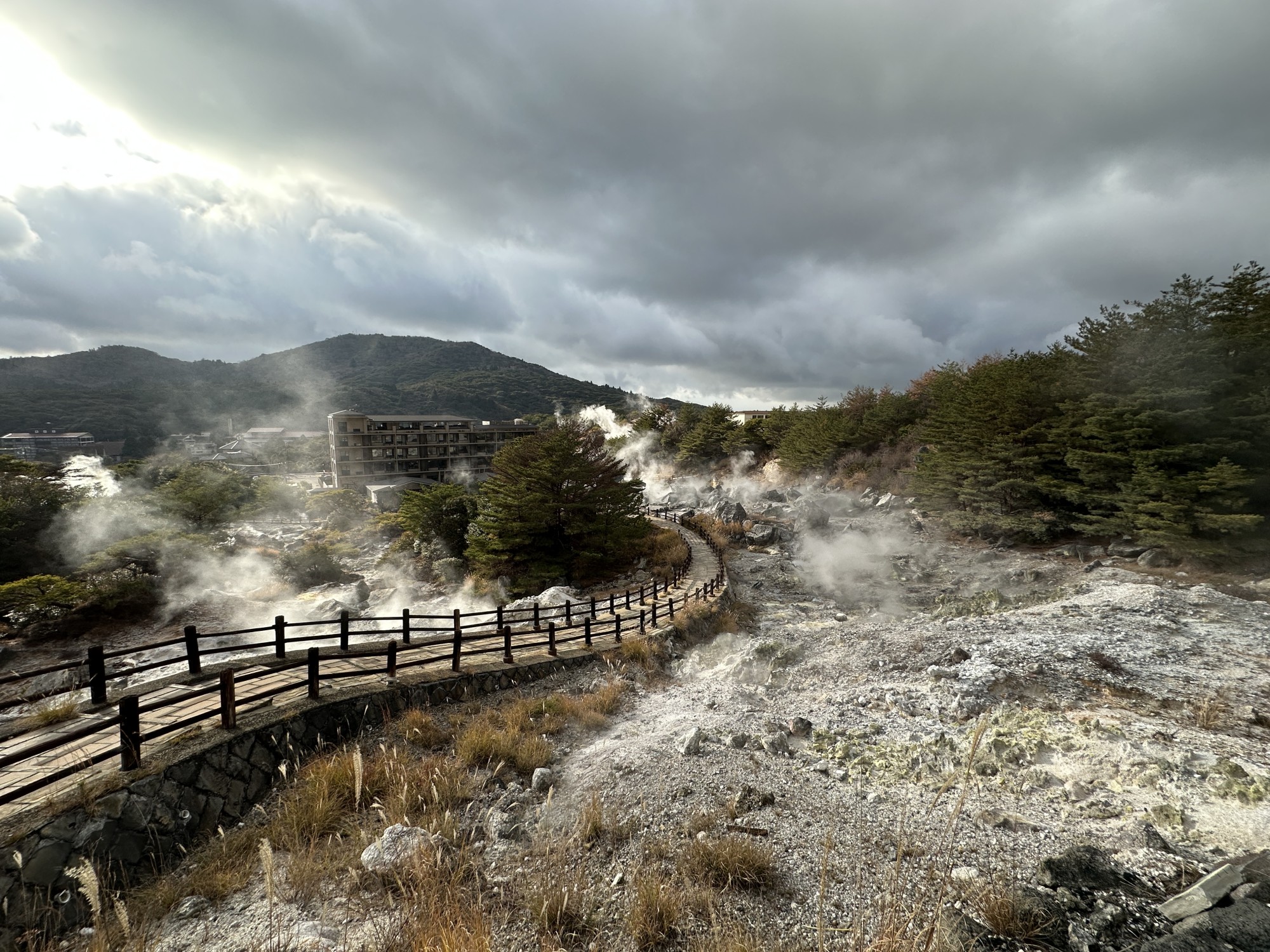
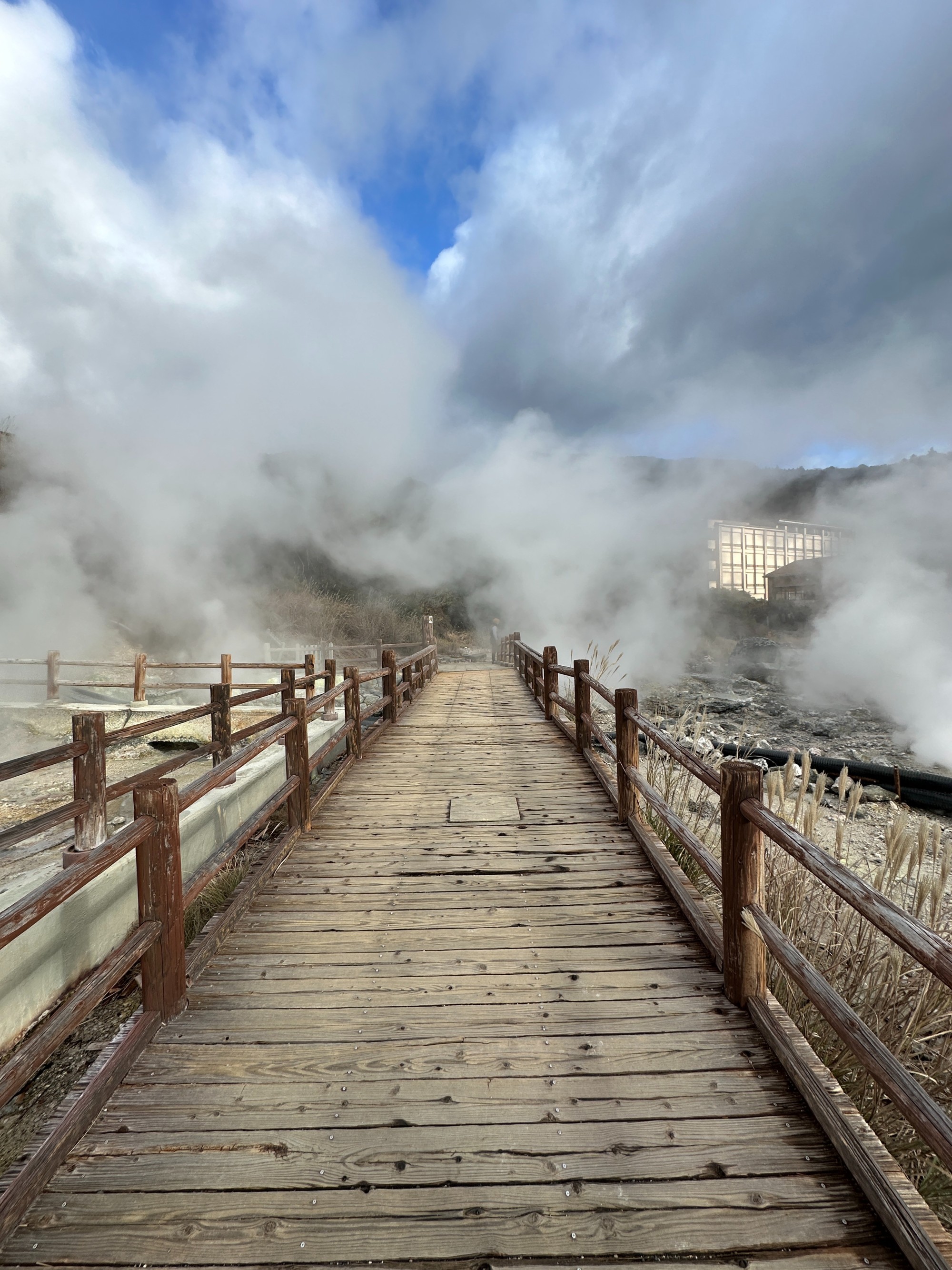
Strolling around Unzen together and, following sulphurous airs, in its centre we find the otherworldly steaming and milky bubbling geothermal jigoku hells. After luxuriating in our accommodation's onsen baths we once again enjoy sumptuous Japanese cuisine for dinner.
Accommodation: Western-style hotel.
Meals: Breakfast & dinner provided.
Total walking: 4.7km (2.9 miles).
Total elevation gain: 55m (180ft).
After a leisurely breakfast, we drive over a high pass to Shimabara, a castle town on the Ariake Sea that was at the centre of the biggest rebellion (1637~1638) against the shogunate throughout the Edo Period (1603-1868). Overly heavy taxation and suppression of Christian locals led to the uprising. Its bloody defeat, the banning of Christianity under pain of death, and expulsion from Japan of the Portuguese followed. On the other hand, the Dutch, who provided assistance to the shogunate's attacking forces, were dealt with more leniently, allowed to remain in Japan and were moved from Hirado to Dejima in 1641.
We enjoy a stroll around Shimabara's photogenic castle and samurai quarters before enjoying lunch at a local restaurant. Shimabara was the scene of another wild event, this time natural, starting in 1989 with earthquake swarms and eruptions from Fugendake, a volcano that towers over the peninsula, that lasted until 1995. At the time, dramatic TV footage of the unfolding events circled the globe. We visit Shimabara's fascinating Gamadas Dome, an interactive museum that tells the dramatic story of these years and the destructive forces unleashed.
Finally, we leave Nagasaki Prefecture on board a fast ferry over the placid Ariake Sea to Kumamoto. Looking back over our shoulder on a clear day provides us with one of our last views of Nagasaki Prefecture; Fugendake's looming presence. A short vehicle journey brings us to the centre of Kumamoto, a thriving and vibrant city where we stay the night. At a restaurant in Kumamoto's nightlife district we enjoy a delicious final dinner together.
Accommodation: Western-style hotel.
Meals: Breakfast, lunch & dinner provided.
Total walking: 2.5km (1.6 miles).
Total elevation gain: N/A.
The tour ends after breakfast and your Tour Leader will be on hand to advise on how to purchase train tickets for onward journeys within Japan or to your departure airport. Please do not hesitate to make your travel requirements known during the tour.
Accommodation: N/A.
Meals: Breakfast provided.
Total walking: N/A.
Total elevation gain: N/A.
This itinerary is subject to change.
Day 1 Fukuoka
Your Walk Japan Tour Leader awaits everyone's arrival in the lobby of our hotel for an early evening start to the tour. The hotel is close by Hakata Station, which is Fukuoka's main railway station and convenient for arrival by both rail and air, and for our departure on Day 2. Your Tour Leader provides the tour briefing before dinner, which continues at a nearby restaurant.
Accommodation: Western-style hotel.
Meals: Dinner provided.
Total walking: N/A.
Total elevation gain: N/A.
Day 2 Hakata – Karatsu
An early breakfast before we catch a local train to the beginning of our walk today on the northern coast of Saga Prefecture. Our luggage is sent ahead of us so all we need to take with us are our day packs.
After about 75 minutes we find ourselves journeying aside the Genkai Sea on Kyushu's northern coast before the view is obscured by a pine forest. Soon after we reach our destination, an unmanned railway station. Here, we are about halfway into the forest which stretches the length of a 4.5km sandy bay. The forest was created in the 17th Century as a bofurin wind break protecting agricultural fields inland, and our path weaves over flat ground through myriad and often primeval looking, wind-blown twisted black pines. Occasionally, we step out onto the sand to enjoy the sea breeze and extensive views up and down the beach.
Soon Karatsu-jo, once the local daimyo lord's fortress residence, comes into view. It is set high on a hill with strategic views over the surrounding seas and Karatsu, the town where we spend the night. Whilst many walk up to the castle we also have the option of an elevator to whisk us to the entrance of the tenshukaku castle keep. From hereon, exploration of the multi-storey interior is only possible by foot. However, it is well worth the effort for the displays on Karatsu's samurai history and towering views over the surrounding countryside and seas.
Lunch, at a restaurant nearby, is followed by a stroll through this charming town. We visit the remarkable Takatori Residence, the former home of a coal tycoon completed in 1905 that combines traditional Japanese and the most up-to-date western architecture of its day. Much makes this building special but the ingenious Noh theatre stage is most extraordinary.
We continue our stroll through the town before making our way to our accommodation for the evening at one of Japan's top inns, a seaside oasis that Jacques Mayol, the French free diver and subject of Luc Besson's 1988 film The Big Blue, held close to his heart. Mayol was born in Shanghai in 1927 and spent summers with his family in Karatsu where he learnt to swim as a child.
Our hosts' warm and helpful hospitality is complemented by excellent cuisine. The inn also incorporates two galleries, where we begin our exploration of the region's famed ceramics.
Accommodation: Traditional Japanese inn.
Meals: Breakfast, lunch & dinner provided.
Total walking: 9.4km (5.8 miles).
Total elevation gain: 68m (223ft).
Day 3 Karatsu – Arita – Sechibaru
In Japan, Saga and porcelain are synonymous and a major subject of our tour today. After a hearty Japanese breakfast, we board a private-hire vehicle for an exploration of how the ceramics industry came to be established here in the 17th Century, its jealously guarded secret, its importance in trade with Europe, and how it thrives to this day. We first visit Okawachi-yama, a quiet pretty village at the top end of a small valley. Although it is still known for its ceramics, little suggests that this was once the closely guarded epicentre of Japan's porcelain industry 350 years ago. Heavily guarded gates once prevented interlopers intent on uncovering the mystery to porcelain production. We gently stroll around the quiet streets lined with galleries and cafes. We also visit the memorial to the Korean potters whose skills were fundamental to establishing the Japanese porcelain arts.
In time, the secret was divulged and ceramic production spread to neighbouring towns including Arita, which has long been considered the epitome of Saga's porcelain. A short drive brings us to this unassuming town. It came to prominence because of the secret ingredient found here in abundance, kaolin, a whiteish, soft earthy deposit. We visit its kaolin workings before strolling through the town, which houses a wide variety of Arita ware, from the traditional to the avant garde, in colourful galleries and chic cafes.
Today, lunch is not included in the tour as Arita offers a variety of restaurants to enjoy at your leisure. Your Tour Leader will advise on where you might like to eat and help settle you in. They will also recommend the best galleries and other sites to visit at your leisure for an hour or so after dining.
This evening, our accommodation is a modern Japanese inn with onsen hot spring baths set high above a valley. The inn is quintessential Japanese modern architecture of the late 20th Century. It was designed by Kisho Kurokawa, a top Japanese architect who also created the Central Plaza 1 in Brisbane, Lane Crawford Place and Republic Plaza in Singapore and the National Arts Center and Nakagin Capsule Hotel in Tokyo amongst many other landmarks around the world. His Metabolist Movement architecture is a striking contrast to Saga's traditional ceramics.
Our accommodation's onsen baths provide us with gentle relaxation and expansive views overlooking the valley below. Afterwards, we enjoy a beautifully presented dinner together while your Tour Leader describes Japan's porcelain and Japan's wider pottery culture in greater detail.
Accommodation: Onsen hot spring resort.
Meals: Breakfast & dinner provided.
Total walking: 3.3km (2 miles).
Total elevation gain: 30m (98ft).
Day 4 Sechibaru – Hirado
Although we have an early start today, do make sure to begin the day with an early morning dip in the onsen baths. Today, we are headed for Hirado, an unusual name for an unusual port town on an island at one of the furthest western extents of Japan. The Portuguese, who were the first Europeans to reach Japan in 1543 made their base here and named it Firando, which was subsequently interpreted by the Japanese into its current appellation.
Hirado is far from much of the rest of Japan but for a short while during the late 16th and early 17th Centuries it held a central role in Japan's relations with Europe. After the Portuguese had left to establish trading further south at a small village, subsequently to become Nagasaki, the Dutch followed, along with William Adams (1564 - 1620), an Englishman whose extraordinary life is the inspiration for James Clavells' best selling novel Shogun and its subsequent hit Hollywood series starring Cosmo Jarvis as the eponymous hero Blackthorne, a.k.a. Adams.
Our guided walking exploration takes us through this very attractive quiet seaside town on an enthralling journey into the earliest days of Europeans in Japan; of Portuguese Jesuits, the Dutch East Indies Company, William Adams' rise to high ranking samurai status and an ill-fated English attempt to trade with Japan. Our stroll includes visits to Hirado's wonderful museum housed in the family residence of the Matsuura daimyo lord, Japan's first ever stone bridge, reconstruction of the Dutch trading post, and memorials to the sailors and traders who risked life and limb to reach Japan over 400 years ago in pursuit of riches. Adams, who is known to this day in Japan as Miura Anjin, died here in 1620 and we pay our respects at his grave.
However, Hirado was not only frequented by Europeans. Chinese traders also found their way here and four years after Adams passed away Zheng Chenggong (1624-1662), also known as Koxinga, was born here to a Chinese merchant and Japanese lady. At the age of seven, Zheng moved to China and rose through the Ming imperial system on merit to become a general, lauded by the Chinese to this day, who resisted the Qing conquests of the 17th Century and drove the Dutch out of Taiwan.
After lunch, we visit the site of Zheng's birth on a beach and a shrine in his honour before exploring the lovely surrounding countryside of Hirado. Our accommodation for the evening is another onsen hot spring establishment.
Accommodation: Western-style hotel.
Meals: Breakfast, lunch & dinner provided.
Total walking: 4km (2.5 miles).
Total elevation gain: 68m (223ft).
Day 5 Hirado – Ureshino
Today, we delve a little further into porcelain, but this time at Hasami in Nagasaki Prefecture. Hasami has been a centre of ceramics production for over four hundred years but its work was long subsumed by its powerful neighbour Arita. Our particular interest is in its recently renewed independence and revival as a centre of contemporary ceramics.
Nearby is Ureshino, one of Japan's top onsen towns that is particularly known for its soft bihada waters that leave skin beautifully radiant. It is also known as a centre of tea cultivation and we spend the day, literally, immersed in every Japanese persons' favourite non-alcoholic beverage. We learn how tea is produced, perfectly brewed and imbibed, the significance of the chado tea ceremony and inextricable relationship with Japan's ceramics.
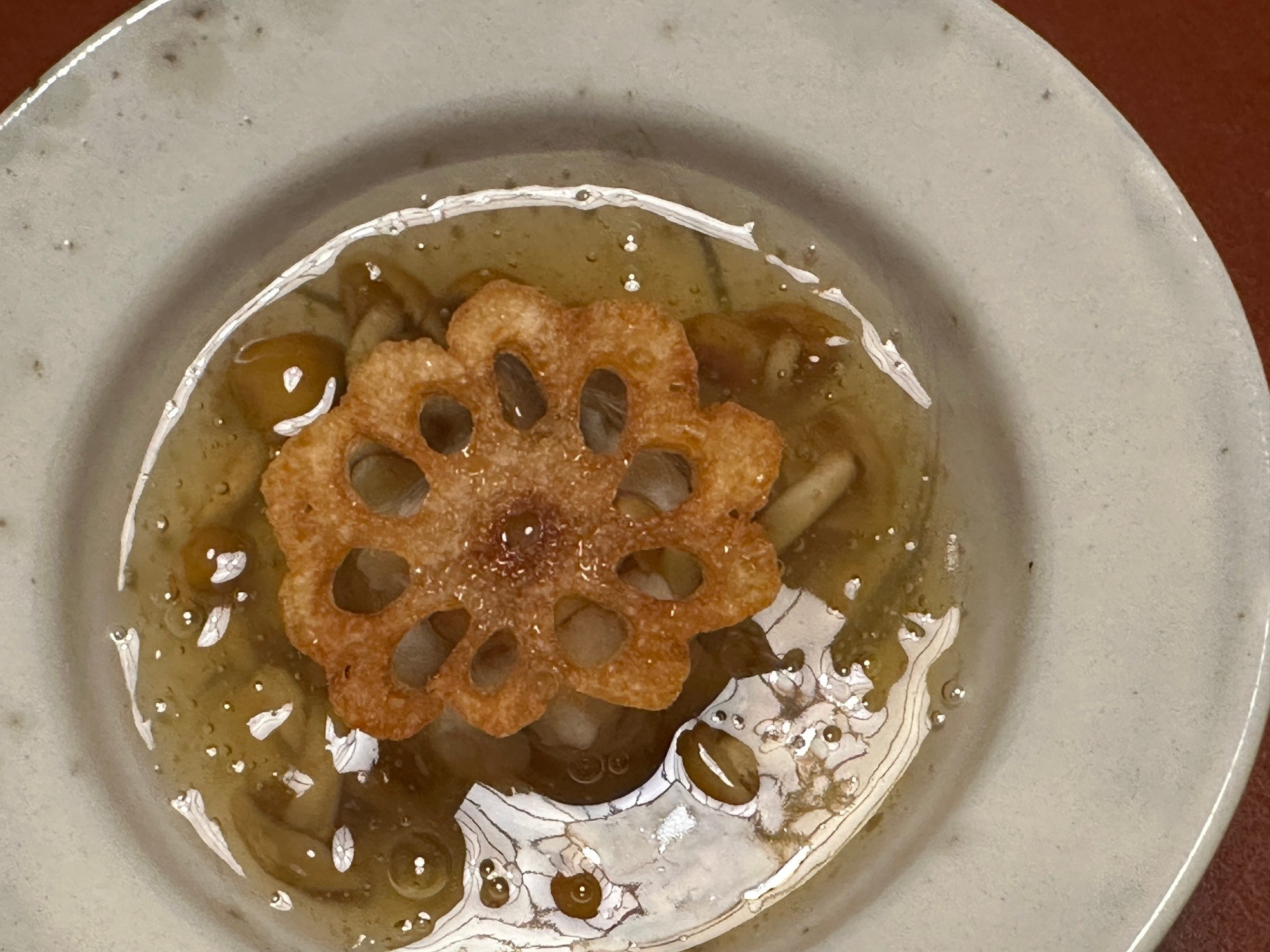
Ureshino was a post town, a stopping point on the Nagasaki Kaido, one of Japan's historic thoroughfares that samurai and Dutch traders alike walked to pay their respects to the shogun in far-flung Edo, modern-day Tokyo. The onsen here really are heavenly and we follow in the footsteps of the many travellers who have luxuriated here over the centuries. Our accommodation provides wonderful hot spring bathing and cuisine with green tea themes.
Accommodation: Onsen hot spring resort.
Meals: Breakfast, lunch & dinner provided.
Total walking: 5km (3.1 miles).
Total elevation gain: 76m (249ft).
Day 6 Ureshino – Nagasaki
After sending our main luggage ahead of us, we catch the West Kyushu Shinkansen bullet train to Nagasaki. However, we will not be sitting down for long as these high speed trains reach speeds of up to 260km per hour and, at only 66km in total length, it is the shortest bullet train line in Japan.
Nagasaki is one of Japan's most intriguing cities. The Portuguese convinced the local daimyo lord that they should establish a trading post, which subsequently became Japan's sole conduit to the rest of the world for over two hundred years, a multi-cultural nexus of Japanese, Westerners and Chinese, centre of Christianity, and notorious as the target of the second atomic bomb.
From high speed transport we transfer to sedate trams to begin our exploration of Nagasaki. This takes us via historic Shinto shrines and Japanese and Chinese temples; wrought stone bridges; a memorial to Puccini and his opera Madam Butterfly that has its roots in the city; Thomas Glover a Scotsman who was instrumental in developing Japan's industrial might and a famous brewery in the late 19th Century; and grandstand vistas across Nagasaki. En route, we enjoy lunch together in Nagasaki’s famed China Town.
Our accommodation is near Shianbashi, Nagasaki's vibrant nightlife district, where we venture out together for our evening meal. Those who wish to explore further after dining will easily find a warm welcome in one of many bars frequented by Japanese and overseas visitors alike, much as happened here over the centuries.
Accommodation: Western-style hotel.
Meals: Breakfast, lunch & dinner provided.
Total walking: 4.8km (3 miles).
Total elevation gain: 78m (256ft).
Day 7 Nagasaki
Nagasaki has so much to offer that we spend two nights in the city to try and make the most of it. This morning, we visit Dejima, a crescent-shaped manmade island that housed first the Portuguese and, after they were expelled from Japan, then Dutch traders who were moved here from Hirado. From 1641 until the 1860s, when western powers flexed their seafaring and military prowess that eventually caused the fall of the shogunate and end of the samurai Edo Period (1603-1868), this tiny island was the only opening between the west and Japan under pain of death. Besides trade, Dejima was also the source of rangaku, literally Dutch studies of the western sciences, technologies and medicine of the day.
Dejima has largely been recreated and provides fascinating insights into Edo Japan and the west, trade, culture, intrigue and the sheer boredom of the Dutch traders who usually had little to do except when a sole trading galleon made its annual visit and entered port.
The rest of the day is free for everyone to explore Nagasaki, which has a very convenient public transport system, is well-versed in English and has a myriad other sites of interest including the Peace Park and Museum, Nagasaki Prefectural Art Museum designed by Tokyo Olympic Stadium architect Kengo Kuma, and Gunkanjima, an abandoned mining town that covers a small island and which features in the James Bond movie Skyfall.
Your Tour Leader will advise on how you may best use your time, and where to enjoy lunch and dinner.
Accommodation: Western-style hotel with onsen hot spring baths.
Meals: Breakfast provided.
Total walking: 4km (2.5 miles).
Total elevation gain: 85m (279ft).
Day 8 Nagasaki – Obama – Unzen
After breakfast, we board a private-hire vehicle for our journey south to the Shimabara Peninsula. We follow the peninsula's western coast which affords us views across the shimmering East China Sea. Obama Onsen, a seaside resort and our initial destination today, is reputed to be the source of the highest temperature hot spring waters, at up to 105 degrees centigrade, in Japan.
Obama is at the foot of Mt. Unzen, one of Japan's more active volcanic regions and the source of the hot spring waters. Wherever we wander on our stroll around town together we come across steam emanating from the ground. Even the restaurant where we enjoy lunch uses onsen waters to steam our dishes of seafood, meats and vegetables to perfection.
After leaving Obama, we quickly climb in our vehicle to Unzen Onsen. In common with Obama, Unzen was founded on its plentiful supply of onsen waters for therapeutic and leisure pursuits and was a popular summer retreat for westerners living in Shanghai and the wider Far East until the late 1930s. It is no surprise, perhaps, to then learn that Japan's second ever golf course and its first public one, a links, was founded here in 1913 and is still popular to this day.
Strolling around Unzen together and, following sulphurous airs, in its centre we find the otherworldly steaming and milky bubbling geothermal jigoku hells. After luxuriating in our accommodation's onsen baths we once again enjoy sumptuous Japanese cuisine for dinner.
Accommodation: Western-style hotel.
Meals: Breakfast & dinner provided.
Total walking: 4.7km (2.9 miles).
Total elevation gain: 55m (180ft).
Day 9 Unzen – Shimabara – Kumamoto
After a leisurely breakfast, we drive over a high pass to Shimabara, a castle town on the Ariake Sea that was at the centre of the biggest rebellion (1637~1638) against the shogunate throughout the Edo Period (1603-1868). Overly heavy taxation and suppression of Christian locals led to the uprising. Its bloody defeat, the banning of Christianity under pain of death, and expulsion from Japan of the Portuguese followed. On the other hand, the Dutch, who provided assistance to the shogunate's attacking forces, were dealt with more leniently, allowed to remain in Japan and were moved from Hirado to Dejima in 1641.
We enjoy a stroll around Shimabara's photogenic castle and samurai quarters before enjoying lunch at a local restaurant. Shimabara was the scene of another wild event, this time natural, starting in 1989 with earthquake swarms and eruptions from Fugendake, a volcano that towers over the peninsula, that lasted until 1995. At the time, dramatic TV footage of the unfolding events circled the globe. We visit Shimabara's fascinating Gamadas Dome, an interactive museum that tells the dramatic story of these years and the destructive forces unleashed.
Finally, we leave Nagasaki Prefecture on board a fast ferry over the placid Ariake Sea to Kumamoto. Looking back over our shoulder on a clear day provides us with one of our last views of Nagasaki Prefecture; Fugendake's looming presence. A short vehicle journey brings us to the centre of Kumamoto, a thriving and vibrant city where we stay the night. At a restaurant in Kumamoto's nightlife district we enjoy a delicious final dinner together.
Accommodation: Western-style hotel.
Meals: Breakfast, lunch & dinner provided.
Total walking: 2.5km (1.6 miles).
Total elevation gain: N/A.
Day 10 Kumamoto
The tour ends after breakfast and your Tour Leader will be on hand to advise on how to purchase train tickets for onward journeys within Japan or to your departure airport. Please do not hesitate to make your travel requirements known during the tour.
Accommodation: N/A.
Meals: Breakfast provided.
Total walking: N/A.
Total elevation gain: N/A.
This itinerary is subject to change.
The itinerary for the Saga and Nagasaki: Cultural Crossroads tour is ground-only, beginning in Hakata (Fukuoka City) and ending in Kumamoto.
The airport closest to the tour start point is Fukuoka Airport (FUK), from where it is a short taxi or subway journey to Hakata Station. Our tour hotel is located nearby. Fukuoka Airport is very well connected to all of Japan’s major airports including Haneda (HND), Narita (NRT) and Kansai (KIX), and many regional Japanese airports. International flights also arrive from many overseas destinations.
The Tokaido Shinkansen bullet train, which starts in Tokyo and travels via Nagoya, Kyoto, Osaka and Hiroshima, terminates at Hakata Station. If travelling to Hakata by train:
-----
FROM TOKYO’S HANEDA AIRPORT (HND)
Tokyo Monorail trains depart for and terminate at Hamamatsu Station. Transfer here to the trains on either the JR Yamanote or JR Keihin-Tohoku Lines for Tokyo Station. To Hakata from Tokyo Station please see the section below.
-----
FROM TOKYO’S NARITA AIRPORT (NRT)
JR Narita Express (N'EX) trains depart every 30 minutes for Tokyo Station. To Hakata from Tokyo Station please see the section below.
-----
FROM TOKYO STATION
The journey to Hakata is made on the JR Tokaido Shinkansen, one of the super-fast bullet train lines. Departures are every 20 to 40 minutes and the journey is approximately five hours.
-----
The pre-tour pack includes detailed instructions, including a map, for travel to the accommodation at the start of the tour.
Please note that travel by train from Kumamoto Station to Narita Airport via Tokyo Station takes approximately 7 hours and to Haneda Airport approximately 6.5 hours.
The airport closest to the tour start point is Fukuoka Airport (FUK), from where it is a short taxi or subway journey to Hakata Station. Our tour hotel is located nearby. Fukuoka Airport is very well connected to all of Japan’s major airports including Haneda (HND), Narita (NRT) and Kansai (KIX), and many regional Japanese airports. International flights also arrive from many overseas destinations.
The Tokaido Shinkansen bullet train, which starts in Tokyo and travels via Nagoya, Kyoto, Osaka and Hiroshima, terminates at Hakata Station. If travelling to Hakata by train:
-----
FROM TOKYO’S HANEDA AIRPORT (HND)
Tokyo Monorail trains depart for and terminate at Hamamatsu Station. Transfer here to the trains on either the JR Yamanote or JR Keihin-Tohoku Lines for Tokyo Station. To Hakata from Tokyo Station please see the section below.
-----
FROM TOKYO’S NARITA AIRPORT (NRT)
JR Narita Express (N'EX) trains depart every 30 minutes for Tokyo Station. To Hakata from Tokyo Station please see the section below.
-----
FROM TOKYO STATION
The journey to Hakata is made on the JR Tokaido Shinkansen, one of the super-fast bullet train lines. Departures are every 20 to 40 minutes and the journey is approximately five hours.
-----
The pre-tour pack includes detailed instructions, including a map, for travel to the accommodation at the start of the tour.
Please note that travel by train from Kumamoto Station to Narita Airport via Tokyo Station takes approximately 7 hours and to Haneda Airport approximately 6.5 hours.